Something is broken at the heart of modern organizations, and the data makes it impossible to ignore. Companies are spending more than ever on training programs, leadership development, and talent acquisition, yet performance gaps continue to widen. Boards demand accountability. Executives commission audits. Consultants deliver frameworks. And still, the same preventable failures repeat themselves with startling regularity.
The problem is not a lack of investment. The problem is a fundamental misunderstanding of what competence actually requires to take root and endure within complex systems.
In this analysis, we will examine why record levels of organizational spending are failing to produce the skilled, capable workforces that leaders expect. We will explore the structural, psychological, and institutional forces that actively undermine competence development even when resources are abundant. More importantly, we will identify the critical gaps between how organizations think about capability building and how high performance actually emerges in practice.
If you are a leader, strategist, or practitioner who has watched well-funded initiatives produce disappointing results, this analysis will give you a sharper framework for understanding exactly why, and what a more effective approach demands.
The Central Paradox of Leadership Development
Organisations collectively spend $366 billion annually on leadership development worldwide, a figure that continues to grow year on year. Yet only 13% of companies report confidence that their programs actually work. Three out of four organisations rate their own leadership development as “not very effective,” and only 18% say their leaders are highly effective at achieving business goals. The industry has treated this data as a resourcing problem. It is not. It is a category error that the field has sustained for decades by refusing to interrogate the assumption at its centre.
The gap data compounds the picture. Seventy-seven percent of organisations globally report experiencing a leadership gap right now, yet only 11% have a strong leadership pipeline to meet current business needs. These two figures sit in direct opposition, and they have for years. What makes this particularly striking is not the size of either number in isolation but the persistence of the distance between them. Awareness of the gap is near-universal; readiness to close it exists in almost none. And when you add the finding that 71% of leaders are assessed as not ready to lead their organisations into the future, you are no longer looking at a performance problem at the margins. You are looking at the dominant condition of leadership in organisations worldwide, and it demands a systemic explanation rather than a scheduling fix.
The dominant industry response to this evidence has been to recommend more training, more frameworks, and more spend. Writing in Inc., Soren Kaplan observed that “budgets are rising while results are flattening” and that most organisations still cannot explain why. The answer, when you look clearly at it, is structural. Only 10% of training is retained without real-world reinforcement, and a 2024 peer-reviewed framework published in Behavioural Sciences confirmed that workplace application of learning is typically low, with many programs underperforming or failing entirely. The problem is not content quality or delivery format. The problem is that organisations keep reaching for training as a mechanism when the actual mechanism is something else entirely.
The paradox resolves the moment you stop treating competence as something that training delivers and start treating it as something that organisations either build or fail to build through culture, structure, and sustained practice. Training can introduce ideas. It cannot, by itself, produce competence. Competence emerges through repeated application, feedback, accountability structures, and an environment that demands and rewards it consistently. Organisations that close the leadership gap do not do so by finding better programs. They do so by building conditions in which competence has to develop because the culture, the structure, and the expectations make anything less unsustainable. That is a fundamentally different problem from the one the industry has been selling solutions to, and it requires a fundamentally different response.
What Competence Actually Means and What It Does Not
Competence is the demonstrated ability to perform effectively within a specific context. It is not the completion of a course, the possession of a certificate, or the confident assertion that one can do the job. This distinction sounds straightforward, yet organisations routinely collapse these separate constructs into a single, dangerously imprecise concept, and the consequences show up directly in performance data. When we treat credential acquisition as proof of capability, we build leadership pipelines on an assumption rather than on evidence.
The conflation of credentialing with competence represents one of the most structurally damaging errors in leadership development. A certificate confirms attendance and, at best, the retention of information at a point in time. It does not confirm that the holder can apply that knowledge under pressure, adapt it to unfamiliar conditions, or produce the outcomes the role demands. The evidence supports this bluntly: organisations spend an estimated $60 billion annually on leadership development, yet peer-reviewed research published in Behavioural Sciences in 2024 finds that “the workplace application of learning is typically low, and many programmes underperform or fail.” The credential gets issued; the capability transfer does not reliably follow. As the research on competence versus credentials from CultureWorks HR makes clear, credentials represent a point-in-time snapshot, not a durable or transferable proxy for real-world performance.
Confidence compounds the problem. Confidence and competence are distinct constructs, and confusing them produces conditions that are actively damaging to organisational decision-making. The Dunning-Kruger Effect describes a well-documented cognitive pattern in which individuals with limited actual capability tend to overestimate their performance, while those with genuine mastery are typically more measured in their self-assessment. High-confidence, low-competence individuals do not simply underperform quietly; they tend to dominate discussions, resist correction, and project a certainty that others read as authority. The U.S. Army Special Forces has formally engaged with the Dunning-Kruger Effect as a framework for metacognitive development in its 2026 training doctrine, a signal that in high-stakes operational environments, the confidence-competence gap is considered dangerous enough to warrant institutional intervention. The implication for corporate leadership development is direct: self-assessed competence ratings are systematically unreliable at the low end of actual capability, which makes 360-degree feedback and observed performance data structural necessities, not optional enhancements.
The dominant direction of HR practice in 2026 responds to precisely this problem. Competence is being repositioned across serious HR functions as a dynamic, context-specific capability rather than a fixed credential tied to a role title or a development programme completed years ago. Skills-based frameworks now measure what people can demonstrably do, not what their tenure or qualifications imply they should be able to do. As the analysis of competency versus skills frameworks from Skills Base shows, operationally sophisticated organisations are moving toward granular, measurable, context-anchored skills assessment and away from broader behavioural competency models that are difficult to verify in practice. Skills-based hiring rose from 56% of companies in 2022 to 73% in 2023, a 17-percentage-point increase in a single year, and that momentum is accelerating into how organisations design not just hiring but promotion, succession planning, and leadership development investment. The organisation that continues to use credential possession or role tenure as its primary competence signal is not operating with a conservative methodology; it is operating with an outdated one.
Why Episodic Training Consistently Fails to Build Durable Competence
The access problem and the effectiveness problem are not the same crisis, and conflating them has allowed organisations to avoid the harder conversation. Yes, 42% of first-time managers assume their roles without any formal preparation, and 75% of managers report they have never received structured leadership training. Those figures are damaging enough on their own. But the more analytically revealing data point sits in what happens when training is provided: only 13% of companies report confidence in their leadership development programmes, against a global annual spend that leadership skills gap research places at $366 billion. The training access problem has a straightforward remedy. The training effectiveness problem is structural, and it demands a different diagnosis entirely.
The structural flaw in episodic training is not one of content quality or facilitation skill. It is a flaw of format. A workshop, a cohort programme, a certification course: each of these delivers information within a bounded event, and information received is not the same as capability developed. Competence, as established in any serious learning science literature, requires repeated application across varied and authentic contexts, with corrective feedback loops and sufficient time for both error and recovery. A structured training event provides none of these conditions by design. It compresses exposure, standardises context, and ends before the participant has had any opportunity to practise in the environment where the capability actually needs to operate. The peer-reviewed evidence published in Behavioural Sciences makes this explicit: workplace application of learning from formal programmes is typically low, and the literature contains only a handful of systematic reviews that isolate what effective design actually requires before, during, and after the training event itself.
The transfer gap is the mechanism through which episodic training fails. What participants absorb during a programme does not automatically convert into on-the-job behaviour, and most organisations do nothing structured in the weeks following a training event to reinforce, practise, or challenge what was covered. There are no deliberate feedback structures, no spaced repetition, no manager accountability for applying what was learned, and no authentic contexts engineered to demand the new capability. The training room closes and the conditions that might have built competence simply do not materialise. This is not a failure of individual motivation; it is a predictable consequence of a delivery model that was never designed to produce durable capability in the first place.
The employee training statistics compiled for 2026 reinforce the demand side of this argument: 65% of workers report they would be more engaged if their manager provided more coaching, and 73% say that having a mentor or coach meaningfully improved their leadership capabilities. These preferences are not incidental. They describe the conditions under which competence actually forms: relational, continuous, context-embedded, and feedback-rich. The pivot toward personalised and continuous development models that defines the 2026 landscape is not a trend driven by preference alone; it reflects an evidence base for programme-driven approaches that has simply not held up under scrutiny.
The 84% of workers who believe a skills gap is affecting their organisation are not, in the main, describing organisations where training is absent. They are describing organisations where training is present but where observable capability change at the point of work is not. The gap they perceive is not between trained and untrained; it is between evidence-based strategies for sustainable learning transfer and the episodic formats that most organisations continue to fund because they are visible, schedulable, and easy to report upward. The investment is real. The competence is not.
Building Competence Without a Formal Development Infrastructure
The structural reality facing most organisations is not that some managers miss out on development. It is that the absence of formal development is the default condition, not the exception. CMI and YouGov research from 2024 puts the figure of managers entering their roles without formal training at 82%, a number that makes the more widely cited 42% look optimistic. These are not isolated failures of individual organisations. They are the predictable outcome of a system that promotes people into management and then expects competence to follow naturally from responsibility. It does not. What organisations therefore need, and what the leadership development industry has consistently under-served, is a practical framework for building competence deliberately when no formal infrastructure exists to support it.
The good news is that formal infrastructure was never the most powerful mechanism for building competence in the first place. The 70/20/10 learning model holds that 70% of meaningful learning occurs through on-the-job experience, 20% through social and peer interaction, and only 10% through formal instruction. If that proportionality is even approximately correct, most competence is already being built outside formal programmes. The critical question is whether it is being built intentionally. Deliberate practice, structured reflection, peer challenge, and feedback-rich environments are all operationally accessible without a training budget, an L&D team, or a learning management system. A structured after-action review following a difficult conversation costs nothing. A peer triad that meets fortnightly to challenge each other’s thinking on leadership decisions requires no programme to sustain. The absence of formal infrastructure is a constraint, but it is not an insurmountable one.
Role-adjacent stretch assignments, when supported with proper coaching and debriefing, produce more durable competence than classroom instruction because they create the conditions that accelerate genuine learning: challenge, consequence, and feedback anchored in real context. Lombardo and Eichinger’s foundational work on experience-driven development established that leaders learn most in situations that push them just beyond their current capability, expose them to novel problems, and require them to adapt in real time. The key differentiator is the quality of support surrounding the stretch, not the stretch itself. A new manager leading a cross-functional project without structured debriefing learns habits, not competence. The same manager with a coach asking the right questions after each major decision develops transferable capability. This is not a resource-intensive proposition. It is a managerial discipline.
That brings the argument to the lever that matters most. Gallup research finds that managers account for 70% of the variance in team engagement scores. That single finding repositions the direct manager, not the L&D function, as the primary driver of capability development. A manager who can name specific competencies, observe behaviour against them, and deliver precise feedback anchored in concrete situations does more to build team capability than any programme a central function could deploy. The Situation-Behaviour-Impact feedback model, or a simple competency observation checklist built into a weekly one-to-one, gives any manager the tools to make this operational without waiting for organisational permission.
With skill gap challenges identified as systemic across organisations globally, responding through formal training routes alone is neither realistic nor sufficient. The organisations that close capability gaps do so by embedding competence development into the culture itself: normalising feedback, creating psychological safety for visible struggle, and ensuring that senior leaders model the behaviours they expect others to develop. Culture either accelerates or undermines every other development mechanism. Without it, even the best-designed programmes decay. With it, scalable enablement through mentorship, peer learning, and deliberate practice becomes self-sustaining. The organisations that wait for formal infrastructure to arrive before investing in competence will keep waiting. The ones that treat competence development as a management behaviour rather than an L&D spend are already ahead.
AI Competence Is a Leadership and Culture Problem, Not an IT Issue
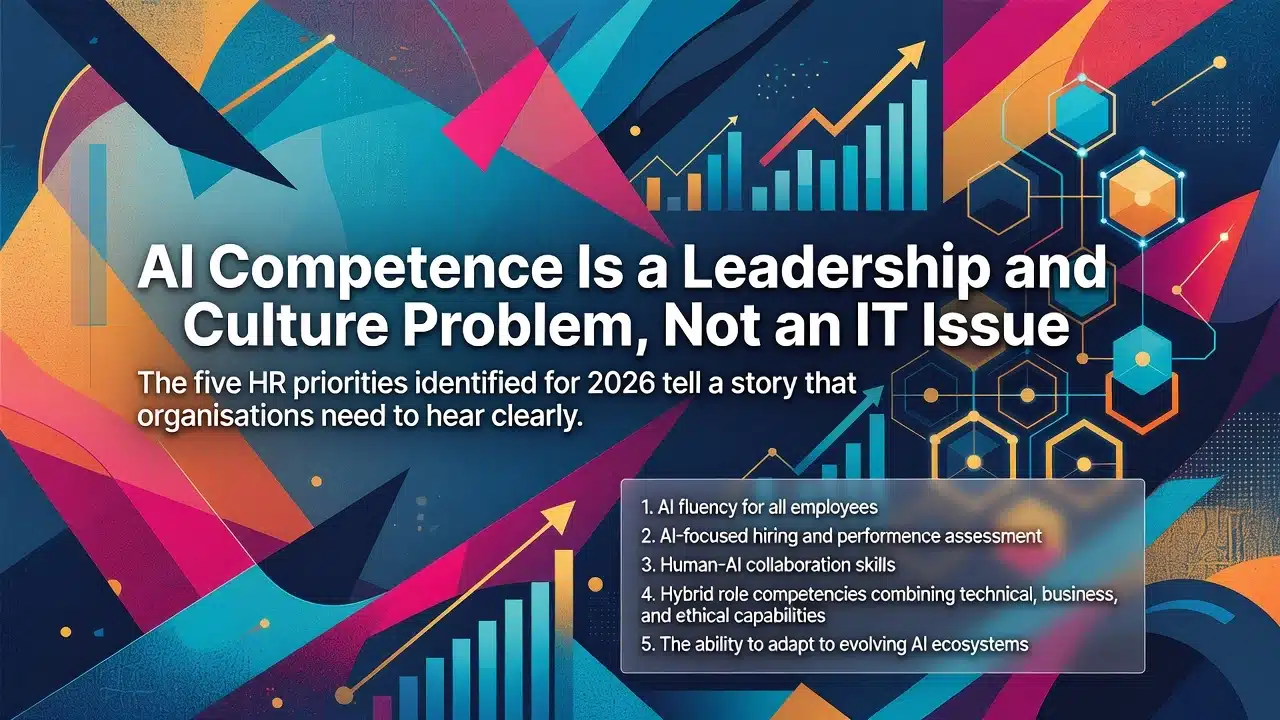
The five HR priorities identified for 2026 tell a story that organisations need to hear clearly. AI fluency for all employees, AI-focused hiring and performance assessment, human-AI collaboration skills, hybrid role competencies combining technical, business, and ethical capabilities, and the ability to lead blended human-AI teams: not one of these priorities belongs to an IT function. Every single one sits at the intersection of leadership capability, workforce strategy, and organisational culture. If your organisation is treating AI competence as a technology problem to be solved by a technical team, it has fundamentally misread where the risk actually lives.
That risk is substantial. The AI skills gap carries an estimated $5.5 trillion economic cost, a figure that immediately repositions the conversation. This is not a digital literacy initiative or a training refresh. It is a core strategic capability requirement that threatens competitive positioning at scale. Two-thirds of CEOs already report that their competitive differentiation depends on having the right expertise in the right roles, supported by active reskilling strategies. The organisations that treat AI competence as an optional layer on top of existing development programmes are not being cautious; they are accumulating a liability.
The deeper problem is that most competence frameworks were built for a world that no longer exists. An organisation that assesses leadership capability against pre-AI criteria is measuring performance against the wrong context entirely. The behaviours, judgements, and skills that defined effective leadership in 2019 are necessary but no longer sufficient. When organisations remain stuck in AI pilot mode, as many currently do, the barrier is rarely technological. The technology is mature enough. The barrier is that operating models, leadership structures, and capability frameworks cannot absorb AI at scale because they were never designed to. Assessing leaders against pre-AI criteria does not surface that gap; it actively conceals it.
What 2026 HR discourse is making explicit is that AI fluency, ethical AI judgement, and the ability to lead teams that include both human and AI contributors are core leadership competencies. They are not specialist skills to be outsourced to a technology function or addressed through a one-time awareness programme. Leading a blended human-AI team requires a leader who can manage, motivate, and measure performance across fundamentally different types of contributors. That demands a new kind of competence: one that combines contextual judgement, ethical reasoning, and the relational intelligence to maintain human trust and cohesion inside a team architecture that has no historical precedent.
The most underappreciated risk in this landscape is what is being quietly neglected while organisations focus their attention on AI tool adoption. The distinctly human competencies that AI cannot replicate, including critical thinking, ethical judgement, contextual interpretation, and the ability to build trust in genuinely ambiguous environments, are not being systematically developed. They are being assumed. Organisations are investing heavily in access to AI capabilities while underinvesting in the human capabilities required to govern, contextualise, and deploy those tools responsibly. The result is an influence gap: AI accelerates functional output while human leadership quality fails to keep pace. That gap does not close itself, and no AI tool closes it for you.
Succession Planning Is a Competence Continuity Problem in Disguise
The statistics alone expose the depth of the problem. Sixty percent of organisations lack effective succession planning processes, and 56% actively struggle with leadership succession. Yet even these figures, striking as they are, consistently get framed in the wrong terms. Boards and executive teams treat succession failure as a planning problem, a process gap, or an HR administrative shortcoming. What it actually represents is a systemic failure to transfer and sustain competence across generations of leadership. That reframing matters enormously, because the solution to a planning failure looks completely different from the solution to a competence continuity failure.
When a high-performing leader exits without a succession plan in place, the organisation does not simply lose a headcount. It loses the accumulated contextual capability that person developed over years of navigating specific clients, specific cultures, specific decision environments and specific failure modes. That capability was rarely made explicit. It was never documented, never tested for transferability, and never embedded in the organisation’s practice in any recoverable form. It lived in judgment calls, in informal networks, in the ability to read a room or pre-empt a problem before it surfaced. When the person walks out, so does every bit of it. Research from Gallup reinforces the structural severity of this: only 5% of organisations have a strong bench of leaders ready to fill succession roles at any given time. The other 95% are one departure away from a capability vacuum.
Reframing succession planning as competence continuity planning changes both the questions organisations ask and the actions they take. The old question is: who will fill this role? The right question is: what specific capabilities must be present in whoever fills this role, at what level of demonstrated proficiency, developed through what experiences over what timeframe, and do the conditions for that development currently exist in this organisation? That question immediately reveals whether the organisation is building a pipeline or maintaining a list of names. Only 35% of organisations have a formal leadership succession plan, even though 69% consider it a high strategic priority. The gap between declared intent and operational reality exists precisely because organisations have confused documentation with development.
The retention case reinforces the competence continuity case directly. Ninety-four percent of employees say they would stay longer if their organisation invested in their learning and development. Succession planning designed around genuine capability development, rather than role-readiness checklists, serves both priorities at once. It signals to employees that internal mobility is real and that growth is not incidental but deliberate. That signal has measurable consequences for retention risk and for the breadth of the pipeline itself.
The organisations treating succession as a names-on-a-chart exercise are making the same structural error as those that treat a training course as a substitute for real development. Both substitute visible administrative activity for the harder, slower work of building actual capability. A chart with successors identified and a one-day leadership programme completed look like progress. Neither is development. Neither builds the competence the organisation will need when the vacancy finally arrives.
Measuring Real Competence Rather Than Training Completion
Most organisations never question the measurement system they use for learning and development because the system feels intuitive. Someone attends a course, completes the modules, passes an assessment, and the learning management system logs a green tick. That green tick gets aggregated into a report, the report gets presented to the board as evidence that development is happening, and everyone moves forward with a quiet confidence that capability has improved. It has not, necessarily. What has been measured is participation, not performance. The distinction sounds semantic until you confront what it costs.
Training completion is an input measure. Competence is an output. The gap between those two things is precisely where the majority of development investment disappears without producing the capability improvements organisations are paying for. The 2026 INE Wired Together Report makes the danger explicit: organisations at the lowest level of learning maturity track activity because “these measures are easy to report, but they provide limited insight into operational capability.” The primary risk the report names is false confidence; leaders know that training occurred, but they do not know whether any meaningful gaps were closed. Across an annual global spend of $366 billion on leadership development, that false confidence is not a minor inefficiency. It is a structural failure operating at enormous scale.
Measuring demonstrated competence requires a fundamentally different design logic. It begins by defining what capable performance actually looks like in a specific role and a specific organisational context, not in the abstract language of a competency dictionary, but in the observable behaviours that distinguish effective from ineffective performance in the conditions that role actually faces. From that definition, assessment becomes a matter of direct observation, structured over time and triangulated across multiple sources. The WEF Future of Jobs Report 2025 found that 39% of core skills are expected to change by 2030, which means any point-in-time completion record is structurally obsolete almost as soon as it is logged. Multi-rater feedback, work samples, situational judgement assessments, and ongoing performance data collected across the tenure of a role produce a far more valid picture of capability than any end-of-programme test. Valid assessment systems, built around real job demands rather than training proxies, are the minimum standard for workforce decisions that carry genuine consequence.
Skills-based assessment frameworks provide the practical infrastructure for making this shift. Progressive HR functions have moved toward models that map competencies against role profiles, calibrate proficiency levels, conduct structured gap analysis, and collect multi-rater feedback on an ongoing basis rather than once per programme cycle. The WEF data showing that 85% of employers plan to prioritise upskilling reflects growing awareness that organisations cannot afford to assume transfer from training participation. They need evidence of demonstrated capability, not records of learning attendance.
The competency verification gap is most visible in technology-adjacent roles, where the cost of invisible weaknesses surfaces rapidly during high-pressure operational events. But the same verification problem runs through leadership development at every level. Closing it requires deliberate design: role-specific capability definitions, direct observation, multi-source feedback, and continuous reassessment as contexts evolve. What it does not require is more training that no one can prove produces the outcomes it claims.
What It Takes to Build a Culture That Develops Competence
Competence is not built by an L&D function alone, and the data makes that case with uncomfortable precision. Every promotion decision, every performance conversation, every feedback norm, and every standard that senior leaders model or neglect functions as a signal about what the organisation actually values. When those signals reward technical output over leadership capability, tolerate vague feedback, or treat development as an annual calendar event rather than a daily operating condition, the organisation is actively constructing the competence deficit it will later claim to be solving. Fifty-nine percent of CHROs in 2025 identified development as the element of employee experience their organisation struggles with most, yet only 45% of employees participated in any skills training for their current role. The structural conditions for competence development are simply absent in the majority of organisations, and no amount of L&D budget resolves a cultural architecture problem.
The promotion decision is where organisations make their most consequential competence policy without recognising it as policy at all. When technical high performers are elevated into management roles without any assessment of leadership capability, the organisation embeds a deficit directly into its management layer and then wonders why performance does not follow. The evidence is unambiguous: 42% of first-time managers arrive in role without any development whatsoever, and only 38% of employees believe their current leaders are adequately prepared to address future business challenges. These are not isolated pipeline failures. They are the predictable output of a system that treats promotion as a reward for past technical performance rather than a decision about future leadership capability. Organisations that continue this pattern are not neglecting development; they are making an active structural choice, and the cost accumulates in every team those underprepared managers lead.
A culture that genuinely builds competence operates differently across three dimensions. It names capability gaps openly and without judgment, creating the psychological safety that 50% of emerging leaders now identify as a development priority. It provides feedback that is specific and behavioural rather than general and evaluative: not “you need to communicate better” but “in last Tuesday’s briefing, you moved to solutions before the team had confirmed the problem, which closed down three perspectives we needed.” And it treats development as a continuous operating responsibility, not an event to be scheduled and then forgotten. Eighty-one percent of professionals believe leadership development should be a continuous process, yet current practice remains episodic. The gap between what people need and what organisations deliver is not a training design problem; it is a cultural design problem.
Senior leaders set these conditions, and the mechanism is not motivational speeches about learning mindsets. It is the standards they visibly hold, the development conversations they actually have, and the degree to which they model continuous learning rather than performed certainty. When senior leaders behave as though they have already learned everything worth knowing, they suppress the learning behaviour they claim to want in others. When they participate in development alongside their teams, the impact is measurable: 62% of employees report increased engagement when their leaders actively participate in development programmes with them, and 68% report performance improvement when their leader receives ongoing coaching and development.
The framework for resilient leadership that underpins this platform positions competence as a cultural and structural responsibility, not a training product to be purchased, deployed, and reported against. The distinction matters more in 2026 than it has at any previous point, because the forces reshaping required competence, including AI integration, skills volatility, and hybrid role demands, are moving faster than any episodic programme can track. Organisations that treat competence as a cultural condition to be built and maintained will outpace those that treat it as a procurement decision. The evidence base for that distinction has never been stronger, and the cost of ignoring it has never been higher.
The Reframe That Changes Everything
Everything covered in this analysis leads to a single, non-negotiable conclusion: competence is not a training problem, and the organisations that continue treating it as one will fall further behind with every passing year. The evidence points consistently in one direction. Stop measuring activity and start measuring capability. Stop scheduling courses and start building conditions. Stop reacting to departures and start developing pipelines deliberately, before the pressure forces inadequate decisions.
Your competency framework needs an honest audit against 2026 realities. If AI fluency, ethical AI judgement, and hybrid role capabilities combining technical, business, and ethical reasoning are absent from your framework, you are measuring performance against criteria designed for a world that has already changed. Fifty percent of CEO successions were unplanned as recently as 2025, and only 21% of organisations have formal succession planning in place. Those figures reflect the cost of treating competence as something to address reactively rather than systematically.
The leaders who will perform in an AI-driven environment are those who can think critically under complexity, judge ethically without algorithmic shortcuts, and lead with the kind of contextual intelligence that no model can replicate. Those capabilities do not emerge from a course completion. They emerge from sustained development embedded in culture, reinforced through feedback, and designed into the conditions people work within every day. That is the reframe. Everything else follows from it.
Leave a Reply