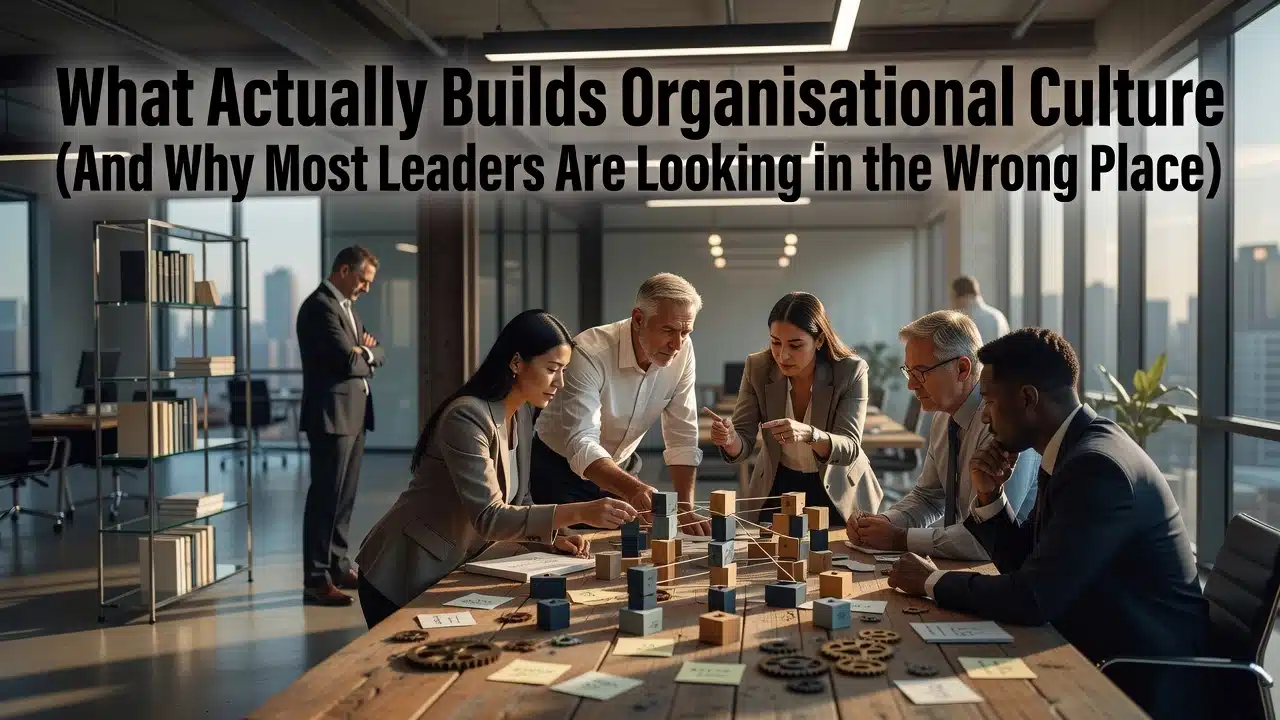
Most leaders believe they are actively shaping their organisational culture through vision statements, away days, and carefully worded values pinned to the office wall. The uncomfortable truth is that these efforts, while well-intentioned, rarely move the needle in any meaningful way.
Organisational culture is not built through what leadership announces. It is built through what leadership tolerates, rewards, and consistently models behind closed doors. The gap between those two realities is where most cultural change efforts quietly collapse.
In this analysis, we are going to examine what actually drives culture at a structural level, why so many experienced leaders misdiagnose the problem, and what the research tells us about the mechanisms that genuinely shift collective behaviour over time. Whether you are trying to understand why a previous initiative failed or looking to build something more deliberate from the ground up, this piece will give you a clearer framework for thinking about the forces already shaping your organisation, whether you intended them to or not. By the end, you will have a more honest picture of where real cultural leverage actually lives.
What Organisational Culture Actually Is
Organisational culture is not what an organisation says it is. It is what people experience repeatedly, in real time, through the behaviour of the people around them. Mission statements, values posters, and employer branding materials describe an intended culture. They do not create one. What actually shapes culture is far more granular: the way a manager responds when someone raises a concern, whether recognition happens publicly or not at all, and how boundaries are communicated when performance slips. These repeated behavioural signals form what researchers describe as an informal code, one that employees absorb through observation long before any formal onboarding document reaches them.
The Micro-Leadership Moment
The fundamental unit of cultural construction is not the annual all-hands meeting or the strategic offsite. It is the 30-second interaction. Micro-coaching happens when a manager pauses to reframe a problem rather than simply redirect it. Micro-recognition happens when a contribution is named specifically and promptly, rather than folded into a generic “well done.” Micro-boundaries happen when a leader calmly clarifies what is acceptable without drama or ambiguity. Individually, each of these moments appears small. Collectively, they determine whether a team operates with clarity, psychological safety, and shared purpose, or with confusion, anxiety, and quiet disengagement. Culture is built in these moments, not between them.
The Gap Between Declared and Experienced Culture
Most organisations have a culture problem they mistake for a communications problem. They invest in sharper messaging, more frequent town halls, and updated values frameworks, and yet the lived experience of employees remains unchanged. This persistent gap between declared culture and experienced culture is almost always a leadership behaviour gap. Research published in BMC Health Services Research found that organisational culture was significantly and positively correlated with leadership behaviour, confirming that what leaders do, not what organisations say, drives cultural reality. When stated values contradict daily manager behaviour, employees do not conclude that the values are aspirational. They conclude that the values are false. That conclusion carries serious consequences.
The 2026 National Workplace Trends Study found that 57% of employees say distrust in leadership makes them consider leaving. That figure does not reflect dissatisfaction with company policy or benefit structures. It reflects the accumulated weight of micro-leadership moments that signalled, over time, that leadership could not be trusted. No communications strategy repairs that damage. Only sustained behavioural change does.
Annual engagement surveys cannot solve this problem, because they do not operate at the level where culture is actually constructed. Surveys measure cultural outcomes after the fact. They capture how employees feel at a single point in time, several months after the leadership behaviours that shaped those feelings have already occurred. By the time survey results surface, the cultural damage or momentum that produced them has already compounded. Leaders who wait for survey data to understand their culture are working with a significant lag. The organisations that build strong, resilient cultures treat every manager interaction as a cultural intervention, understanding that organisational culture research consistently links cultural strength to measurable retention and performance outcomes. Culture is not an annual event. It is a continuous output of leadership behaviour, moment by moment, interaction by interaction.
The Middle Management Problem
The most common and least-addressed failure mode in organisational culture is not toxic leadership or misaligned strategy. It is the routine, unremarkable act of promoting an excellent individual contributor into a management role without equipping them to lead people. Organisations reward technical excellence with positional authority, then assume that cultural leadership will follow automatically. It does not. The behaviours that made someone outstanding as an individual performer, precision, personal output, task ownership, are frequently the opposite of what effective people leadership requires.
The Scale of the Problem
The data confirms this is not an occasional oversight. It is the default condition. According to the Chartered Management Institute, cited in People Management (2025), 82% of workers entering management positions in the UK have had no formal management or leadership training. That figure does not describe a minority falling through the cracks. It describes the overwhelming norm. For every ten people promoted into management in the UK, eight arrive without any structured preparation for the role they are about to perform. The system is not occasionally failing; it is consistently producing untrained managers at scale.
One might reasonably ask whether this is a specifically British problem. The Gallup 2025 State of the Global Workplace report confirms it is not. Only 44% of the world’s managers report having received management training, meaning the majority of managers globally are operating without formal preparation. Two independent data sources, one national and one global, converge on the same conclusion. Undertrained management is not an anomaly. It is the worldwide default condition that organisations have quietly normalised.
What makes this pattern particularly striking is that the problem begins before the training gap. Gallup research also finds that companies fail to choose candidates with the right talent for management roles 82% of the time. The same percentage appears twice, independently: once for selection failure and once for training failure. Organisations are selecting the wrong criteria at the point of appointment and then compounding that error by providing no development once the appointment is made. This is not a pipeline problem or an HR oversight. It is a systemic design failure embedded in how organisations think about progression and reward.
The Downstream Cultural Consequences
The cultural damage that follows does not arrive all at once. It accumulates quietly, beneath the surface of performance data, until it becomes visible in ways that are expensive and difficult to reverse. An undertrained manager defaults to what they know, which is individual task execution, not team clarity. Accountability structures blur. Feedback becomes infrequent or inconsistent. Priorities shift without explanation.
High performers on those teams disengage first and fastest. They are most sensitive to the loss of direction, recognition, and developmental challenge because those are the conditions that originally drove their performance. Their disengagement is rarely loud. They stop volunteering ideas. They execute without contributing. Eventually, they leave. By the time attrition data surfaces in HR reporting, the cultural erosion has been underway for months. The signal arrives long after the damage has taken hold, which is precisely what makes promotion-without-preparation so costly and so consistently underestimated by the senior leaders who perpetuate it.
The Accidental Manager: A Cultural Failure Mode
The accidental manager is not a rare exception. According to the Chartered Management Institute, 82% of managers in the UK enter leadership positions without any formal management or leadership training. The archetype is consistent: a high-performing individual contributor, recognised for technical output, is promoted into a people leadership role on the basis that excellence in the work predicts excellence in leading others. It does not. The organisation has rewarded what it could measure and assumed the rest would follow. The result is a manager who carries the skills of an individual contributor into a role that demands something fundamentally different: the ability to build, sustain, and shape team culture through daily behaviour.
Why Task Management Becomes the Default
The accidental manager does not choose task management over cultural leadership out of indifference. They default to it because it is the only fluent language they have. As research from Weber State University confirms, the promotion logic is straightforward but flawed: technical success is visible, measurable, and rewarded. Interpersonal competence is neither tested nor developed before the transition. So when pressure arrives, which it does immediately, the accidental manager reverts to the behaviour that earned the promotion in the first place. They manage tasks, monitor outputs, and solve problems directly, because those are the activities that once defined their success. What gets abandoned is precisely what teams need most: coaching conversations, developmental feedback, recognition of individual contribution, and the relational investment that signals to people that their growth matters.
The 2026 National Workplace Trends Study found that 36% of employees rank constructive feedback and recognition as a top leadership priority. These are relational behaviours. They require attention to individuals, the ability to communicate value clearly, and a commitment to growth conversations that sit beyond the task itself. Daniel Boniface, writing on the accidental manager pattern, notes that new managers frequently report feeling overwhelmed and isolated, responsible for everything but equipped for little. The team’s most pressing cultural needs and the manager’s actual capability are pointing in opposite directions from day one.
When One Problem Becomes an Organisational Crisis
The aggregation dynamic is where individual failure becomes systemic damage. One undertrained manager creates a difficult team environment: feedback disappears, development stalls, and trust erodes quietly. Multiply that across ten managers, and the pattern is no longer a people problem. It becomes the cultural operating norm of the organisation. Teams learn to expect compliance over contribution. Silence replaces feedback. Output is tracked; growth is not. The culture does not shift dramatically or visibly. It degrades steadily, through the accumulation of thousands of small moments in which the relational needs of employees go unmet.
Senior leadership rarely identifies the root cause accurately. The symptoms, higher turnover, disengagement, and fragile morale, are visible. The cause, a management layer promoted without the behavioural competencies to lead, is less so. Organisations invest in benefits, flexibility, and technology in response, and the problem persists. It persists because the mechanism of culture is the daily behaviour of the managers closest to the work, and that behaviour has never been developed to meet the demands of cultural leadership.
The Culture-Competence Link No One Is Making
Most organisations treat leadership development and culture programmes as separate workstreams with separate budgets, separate owners, and separate success metrics. This separation is not just inefficient. It is structurally wrong. Individual competence development and organisational culture outcomes are not parallel programmes running alongside each other; they are the same system operating at different scales. What a leader does in a one-to-one conversation becomes the behavioural norm for a team of ten. What ten managers do becomes the lived reality for a hundred employees. Culture is not built in strategy sessions. It is built, or dismantled, in accumulated moments of individual competence or its absence.
The evidence supports this directly. Research across 641 employees published in the International Journal of Environmental Research and Public Health found that the interaction between employee competency type and organisational culture type is a primary driver of perceived stress and performance outcomes. The study’s conclusion is significant: HR practitioners must match organisational culture with employee competency rather than treating them as independent levers. In other words, separating competence development from culture strategy does not just miss an opportunity; it actively undermines both.
When Competence Gaps Become Cultural Signals
A leader who lacks coaching competence does not simply underperform as an individual. They actively degrade culture at the team level, and that degradation aggregates. Consider the arithmetic: one manager who avoids giving feedback creates a feedback-free environment for eight to twelve direct reports. Those employees learn, implicitly and powerfully, that feedback is not part of how this organisation operates. Multiply that pattern across a management layer and the cultural signal becomes structural. It is no longer one person’s weakness. It is an organisational norm, and norms are the architecture of culture.
Three competence gaps sit at the centre of this erosion. The first is the inability to give constructive feedback. Without it, employees cannot calibrate performance or develop capability; cultures without feedback norms become simultaneously stagnant and anxious. The second is the failure to set and hold boundaries. Every boundary a leader fails to enforce sends a permission signal. Those signals diffuse rapidly through teams, normalising behaviours that undermine clarity, fairness, and trust. The third is the absence of meaningful recognition practices. Gallup’s ongoing research consistently identifies recognition as a core engagement driver, and its absence does not simply demotivate individuals; it erodes the cultural belief that contribution is valued. These are not soft skills. They are load-bearing elements of cultural infrastructure.
Reframing the Return on Leadership Development
The financial case for treating competence development as a cultural investment is substantial. DDI’s research reports a 424% return on investment from leadership development programmes measured against real organisational outcomes. That figure reframes the conversation entirely. A training budget line is discretionary spend. A cultural infrastructure investment with a 424% return is a strategic priority.
This reframing matters because it changes what organisations measure. When competence development is treated as training, the metric is completion rates. When it is treated as cultural investment, the metric is behavioural change and its measurable effect on team and organisational outcomes. The approach developed at DarrenWalley.com operates on exactly this principle: individual leader behaviour change is the unit of cultural change, and evidence-based competence building is the mechanism that connects one to the other. This is not generic content delivered to a room and measured by attendance. It is precision work, matching competence development to the specific cultural conditions of the organisation, and measuring the result in the cultural indicators that actually matter.
AI, Hybrid Teams, and the New Cultural Variables
The workforce composition that leaders now manage bears little resemblance to the structures that shaped traditional culture frameworks. Full-time employees, contractors, gig workers, and AI agents increasingly operate within the same cultural system, yet each group carries different expectations, commitments, and relationships to organisational norms. A contractor hired through a platform has no emotional investment in the company’s stated values. An AI agent processes tasks without cultural context. A gig worker moves between organisations fluidly, carrying fragments of multiple cultural identities. Traditional frameworks assumed a relatively stable, bounded workforce. That assumption no longer holds, and leaders who continue to apply those frameworks to blended teams will find coherence progressively harder to maintain.
Relational Intelligence as the New Leadership Currency
The competency most often cited as essential for this environment is emotional intelligence. It remains valuable. However, emotional intelligence was designed for one-to-one and small group dynamics; it focuses on reading and responding to individual emotional states. What distributed and AI-blended teams actually require is something more systemic. Relational intelligence, as a successor concept, shifts the focus from individual relationships to the flow of trust, communication, and influence across an entire system. A relationally intelligent leader does not just manage relationships; they map how information moves, where trust accumulates or breaks down, and how influence actually operates across a team that may never share the same physical or even temporal space. This distinction matters practically. In a team where a contractor holds critical knowledge but no psychological stake in the outcome, a relationally intelligent leader spots that structural vulnerability before it becomes a cultural failure.
AI Transparency as Psychological Safety in Practice
One of the most underexamined cultural dynamics in 2026 is how leaders handle AI use within their teams. Leaders who openly narrate their use of AI tools, distinguish clearly between automated outputs and human judgement, and actively teach teams to use AI for thinking rather than simply for task completion are doing something culturally significant. They are demonstrating that ambiguity can be named rather than hidden. This transparency directly builds psychological safety, which is a core cultural outcome rather than a soft benefit. When a leader models intellectual honesty about what AI can and cannot do, they reduce the anxiety that many employees feel about being displaced or evaluated against machine outputs. The cultural signal is clear: uncertainty is not a threat to be concealed; it is a condition to navigate together.
Gallup’s formal listing of AI Adoption alongside Culture as a discrete advisory practice area confirms that leading enterprise organisations have already moved past the speculative phase. They are treating AI integration as a structural cultural concern, which means leaders who are still managing AI adoption as a purely operational or technological matter are operating behind the curve of where serious organisational investment already sits.
Cognitive Flexibility as a Cultural Stabiliser
Cognitive flexibility deserves attention as a leadership competency with direct cultural implications. Leaders who can hold competing truths simultaneously, without forcing premature resolution, create a particular kind of stability that teams find anchoring in volatile conditions. According to research on emerging leadership trends, the ability to normalise uncertainty rather than perform false confidence is becoming a defining characteristic of leaders who sustain cultural health across politically and economically turbulent periods. When leaders model this openly, teams internalise the same cognitive posture. The cultural outcome is an organisation that can adapt its thinking without fracturing its identity, which is precisely the resilience that current conditions demand.
AI Adoption as a Psychological Safety Test
Every decision a leader makes about AI, including the decision to say nothing, sends a message to their team. The message travels faster and lands harder than any policy document or implementation guide. Research from Gotham Culture confirms that 83% of executives acknowledge psychological safety measurably improves AI adoption success, yet only 39% rate their organisation’s psychological safety as very high. That 44-point gap is not a technology problem. It is a leadership behaviour problem, and it sits at the heart of organisational culture.
Automation Versus Augmentation
There is a meaningful distinction between using AI to complete tasks and using AI to extend thinking. Automation replaces effort. Augmentation builds capability. When a leader uses AI to draft a report and circulates it without comment, the team receives an output but learns nothing. When a leader narrates their reasoning, explains the prompt they used, and invites the team to interrogate the output together, they are doing something culturally significant. They are modelling intellectual transparency, normalising uncertainty, and building shared capability at the same time. Teaching teams to use AI for thinking, not just for doing, is a cultural act. It shapes identity, reinforces values, and creates a shared language for how the team approaches problems. Workers who feel confident using AI are twice as likely to be highly engaged as those who do not, and that confidence does not come from access alone. It comes from trust, psychological safety, and evidence that AI will support rather than replace them.
The Silent Adopter Problem
The cultural risk of silent AI adoption is specific and serious. When a leader privately uses AI to shape decisions, draft communications, or analyse data, but publicly espouses values of transparency and collaboration, a perception gap opens. Teams notice unexplained shifts in output quality, response speed, or analytical depth. They draw conclusions. Those conclusions rarely favour the leader. The gap between declared values and observed behaviour is precisely what erodes trust in organisations, and AI creates new and harder-to-detect versions of that gap. Inc. Magazine states plainly that leadership sets the standard and culture for integrating AI tools. Leaders who set that standard through silence set it badly.
Measuring Culture Beyond Engagement Scores
Standardised engagement surveys have a structural flaw that most organisations never examine. They measure how employees feel about culture after the behaviours that shaped those feelings have already occurred. By the time a declining score surfaces in a quarterly report, the behavioural shifts behind it have typically been visible for weeks, sometimes months. The survey captures the outcome. It misses the cause entirely. Culture and engagement are related, but they are not the same thing, and treating one as a proxy for the other creates a dangerous measurement blind spot.
The Signals That Arrive Before the Survey
Leaders who wait for survey cycles to diagnose cultural health are systematically late. Cultural erosion does not announce itself. It accumulates quietly through observable behavioural patterns that require no enterprise platform to detect. Four early-warning indicators consistently precede measurable disengagement.
Declining peer-to-peer recognition is often the first to disappear. When colleagues stop voluntarily acknowledging each other’s contributions, it signals eroding psychological safety and weakening team cohesion, long before anyone marks a survey question lower. Increased escalation behaviour is equally telling; when routine decisions travel upward rather than being resolved laterally, trust between peers has broken down. Rising task-level conflict, particularly friction over roles, processes, and outputs rather than ideas, indicates that value misalignment is surfacing at the operational level. Finally, withdrawal from discretionary contribution captures what engagement researchers call the leading edge of disengagement: employees stop attending informal discussions, opt out of non-mandatory initiatives, and gradually reduce the effort they were never contractually required to give.
Each of these signals is directly observable. None of them requires a survey.
Cultural Drift Is Quiet Until It Isn’t
Cultural deterioration rarely resembles a crisis. It resembles nothing, until it suddenly resembles everything. The pattern across organisations is consistent: micro-signals accumulate over months, each one small enough to rationalise or ignore, until the collective weight becomes visible as turnover, performance decline, or team fracture. Leaders who later describe their culture as having “collapsed suddenly” almost always missed a long sequence of unaddressed signals that preceded it.
This is the mechanism of cultural drift. It is not a sudden event. It is a slow, quiet process in which small behavioural changes compound without correction. The tragedy is that most of these signals are observable in real time, by anyone paying attention.
A Team-Level Diagnostic Leaders Can Use Now
Leaders do not need an HR reporting cycle to assess cultural health. The following questions can be applied directly at the team level, in real time.
- When did someone on this team last publicly acknowledge a colleague’s contribution without being prompted?
- Are routine decisions being made at the right level, or are they consistently being escalated to me?
- Has the nature of disagreements on this team shifted from ideas and approaches toward tasks, roles, and blame?
- Who has reduced their involvement in team discussions or voluntary activities over the past four to six weeks?
- Would members of this team feel safe raising a concern about how we work together, without fear of consequence?
These questions do not replace formal measurement. They create a real-time feedback loop that formal measurement cannot provide.
The Case for Multi-Signal Measurement
Relying on a single metric to assess organisational culture is the equivalent of using one instrument to navigate a complex environment. Engagement scores provide a useful, if lagging, snapshot. They become genuinely actionable only when read alongside behavioural observation, peer feedback patterns, internal mobility data, and psychological safety indicators. A team can score well on formal engagement while simultaneously exhibiting every early-warning signal described above, as illustrated by the not uncommon scenario in which high satisfaction survey results coexist with rising stress pulse data and cultural disconnect surfacing in exit conversations, with none of the three datasets communicating with each other.
Psychological safety deserves particular attention as a standalone leading indicator, distinct from general engagement. It measures whether people believe they can speak up, take risks, and challenge the status quo without punishment. Where psychological safety is low, the other signals invariably follow. A multi-signal approach treats behavioural observation, peer feedback patterns, and psychological safety data as equally valid inputs alongside formal survey data, because culture is built in the space between survey cycles, in the daily interactions that no questionnaire captures in time.
Early Warning Indicators Leaders Can Act On
Cultural erosion rarely announces itself. It accumulates through small, repeated moments that individually seem unremarkable but collectively signal that something significant is shifting beneath the surface of everyday team life.
Five observable signals deserve a leader’s immediate attention. Reduced voluntary communication appears when team members stop offering ideas, asking questions, or sharing informal updates. Meetings become one-directional. Avoidance of accountability conversations emerges when difficult performance discussions get deferred or sidestepped entirely, normalising a standard no one explicitly agreed to. Declining discretionary effort shows up as a quiet withdrawal of the extra contribution that no job description mandates, but every high-performing team depends on. Increased blame attribution replaces collective problem-solving with finger-pointing, and setbacks become opportunities to assign fault rather than extract learning. Loss of shared language around values is perhaps the most telling signal; when team values drift from lived reference points into background noise, cynicism fills the gap.
Each signal maps directly to a leadership behaviour gap. Reduced communication reflects a deficit in psychological safety and approachability, addressable through active listening and structured invitation of dissent. Accountability avoidance points to underdeveloped feedback skills, not poor character; targeted coaching competence closes this gap faster than any policy change. Declining discretionary effort reveals a gap in purpose communication and meaningful recognition. Blame culture signals that the leader has not modelled ownership of mistakes or separated person from problem in post-failure conversations. Eroding shared language exposes misalignment between what leaders say they value and what they consistently reward.
Structural interventions, such as reorganisations or revised frameworks, do not fix behaviour gaps. Targeted competence development does. The distinction matters enormously for how leaders invest their attention and where organisations direct development resources.
The most important insight is deceptively simple. Early detection is not a measurement system. It is a leadership skill built on deliberate, sustained attention to the people closest to you. No dashboard captures the hesitation before someone speaks. No survey detects the shift in tone when a leader leaves the room. The most effective cultural diagnostic tool available to any organisation is a manager who is genuinely paying attention to what is happening around them, and who has developed the competence to understand what they are seeing.
What Leaders Can Do Starting Now
The evidence is unambiguous. Gallup’s research consistently identifies the manager as accounting for at least 70% of the variance in team engagement scores. Culture does not change through programmes. It changes through the accumulation of daily, repeatable, low-cost interactions that leaders are already having, whether they are intentional about them or not. The micro-leadership moment framework makes that intentionality practical and sustainable.
Three Practices You Can Start Today
Three specific actions build cultural clarity without requiring new budget, new tools, or new initiatives.
The first is delivering one piece of specific, behavioural recognition per day. Not general praise. Not “great work this week.” Something precise: “The way you reframed that client concern in Tuesday’s meeting turned the conversation around. That showed real commercial awareness.” A PLoS One study published in January 2025 confirmed that recognition significantly boosts engagement and reduces burnout when it is targeted and consistent. The compounding effect is real. Thirty deliberate recognitions per month create a measurable cultural signal. They tell the team which behaviours matter and demonstrate that the leader pays attention.
The second practice is asking one open question in every team interaction that invites perspective rather than reporting. The distinction matters. “Where are we on the project?” invites status. “What’s the part of this project that feels most uncertain to you right now?” invites thinking. Questions like “What would you do differently if you had more time?” or “What is the team not saying that we probably should be?” build psychological safety directly. Teams with high psychological safety outperform others by 22% in productivity and show 27% lower turnover, according to a 2024 meta-analysis cited in the Harvard Business Review. The question costs nothing. The cultural outcome compounds.
The third practice is naming one value explicitly when making a decision visible to the team. When a leader says “I chose to prioritise transparency here because it is one of the things we say we stand for,” they connect lived behaviour to stated belief. This closes the trust gap that inconsistency creates and builds cultural coherence over time.
The Self-Audit Comes First
Before attempting to shift team culture, leaders should audit their own micro-behaviour. A simple weekly reflection practice achieves this. Each week, ask three questions: Which of my interactions this week reinforced the culture I intend to build? Which interactions undermined it? What will I do differently in the next five days? This practice requires ten minutes and no external facilitation. It does, however, require honesty. Inconsistency between stated values and daily behaviour is a primary driver of cultural fragility, and leaders are frequently the last to see it in themselves.
Anchoring in Values During Volatility
The calm leadership imperative matters most when external conditions are unstable. Leaders who anchor decisions in shared values and practise basic scenario thinking, by naming two or three possible outcomes before committing to a direction, create organisational stability that directly counteracts cultural fragility. Teams do not need their leaders to have all the answers. They need to see that their leaders are reasoning from a consistent set of principles, even under pressure.
Behaviour change at the individual leadership level is the starting point. Sustaining it requires a structured framework that connects daily micro-practices to broader competence development. DarrenWalley.com provides evidence-based tools, frameworks, and practical resources for leaders ready to move from awareness to consistent application, building the kind of leadership competence that makes cultural health a measurable, repeatable outcome.
Culture Is Built in Moments, Not Meetings
Organisational culture is not a programme you launch, a survey you run, or a set of values you laminate and mount on a wall. It is the accumulated weight of small decisions, repeated daily, by the people closest to the work. Every conversation a middle manager has, every competence gap they address or ignore, every signal they send about AI use within their team, these are the moments that build or erode culture in real time.
Three arguments have run through this analysis. Culture is manufactured at the team level by middle managers, not declared from boardrooms. Competence and culture are the same system; when people cannot do their jobs well, the frustration becomes the culture. And AI is already a cultural variable, requiring active leadership rather than passive observation.
Organisations that treat middle management development, competence building, and AI integration as cultural investments, rather than operational afterthoughts, are the ones that will build resilient, high-performing teams in 2026 and beyond. The question is not whether culture matters. The question is whether your leaders are equipped to shape it intentionally, in the moments that count.
If you are ready to move from insight to action, explore the leadership and competence development resources at DarrenWalley.com. The starting point is always the same: are your middle managers equipped to make the right moments?
Leave a Reply