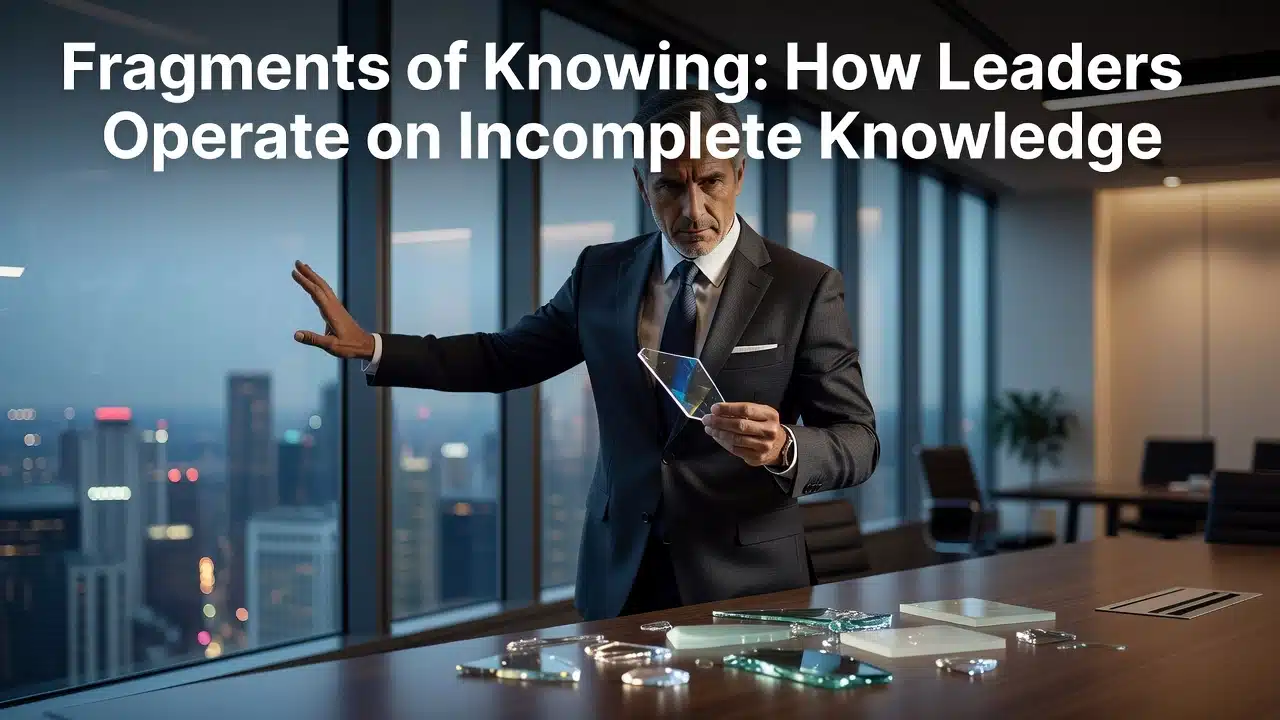
Every major decision a leader makes is built on incomplete information. The full picture is never available, yet choices must still be made. Strategies must still be set, and teams must still be led forward with confidence. This is the quiet reality behind effective leadership that rarely gets discussed openly.
This analysis explores the concept of fragments of knowing, the idea that leaders consistently operate not on comprehensive data. But on partial signals, pattern recognition, and informed intuition. Understanding how this works is not a concession to uncertainty; it is actually a foundational leadership skill in itself.
In the pages ahead, you will learn how experienced leaders construct reliable judgment from limited inputs, why waiting for complete information is often the costliest decision of all, and what cognitive frameworks separate leaders who thrive under uncertainty from those who stall within it. Whether you are navigating a complex organizational challenge or refining your strategic thinking, this examination of fragments of knowing will sharpen how you process ambiguity and act with greater precision when the full picture simply is not there.
The Illusion of Complete Knowledge
Leaders routinely walk into high-stakes decisions carrying a knowledge picture they believe is complete. It is not. Research on the illusion of explanatory depth establishes that people feel they understand complex phenomena with far greater precision and coherence than they actually do, and this illusion is strongest in environments dense with dashboards, briefings, and confident-sounding reports: exactly the environment senior leaders occupy. The problem is not that leaders are careless or unintelligent. The problem is structural. Knowledge fragmentation is built into how organisations generate, hold, and share information, and no amount of effort or seniority removes that constraint.
Fragmentation Is Built Into the System
Cognitive scientists Steven Sloman and Philip Fernbach capture the mechanism precisely. In their analysis of how knowledge outruns individual human brains, they argue that cognition is distributed across bodies, environments, and communities. What any individual believes they know depends on a wider system they neither fully control nor fully see. Inside organisations, this distributed reality collides with hierarchical structures that actively restrict information flow. Those closest to the work hold critical tacit knowledge. Senior leaders rarely access it. Reporting chains distort signals. Briefings compress complexity. The knowledge any single leader carries is therefore partial by design, not by accident.
The Confidence Gap
The specific danger is not ignorance. Ignorance is manageable when you know it exists. The danger is the confidence that wraps unrecognised ignorance. D.D. Warrick’s research identifies this as a distinct leadership failure mode: leaders who assume they know more than they actually do, operating on flawed paradigms they cannot see as flawed. Those around them often reinforce the illusion by softening candid feedback to avoid consequences. Confidence, not competence, drives the room.
This article argues that the core problem facing leaders is not a lack of knowledge. It is the absence of a map of what they are missing. The illusion of knowledge in leadership produces decisions that feel well-grounded but rest on invisible gaps. The sections that follow examine the forces that produce fragmentation at scale and the practical disciplines leaders can use to think and act more clearly within it.
What Knowledge Fragmentation Actually Means
Knowledge fragmentation is the condition in which an organisation’s knowledge exists in disconnected pieces across individuals, systems, teams, and time, rather than as a coherent, accessible whole. It is not a filing problem or a technology gap. It is a structural condition in which employees cannot reliably locate what the organisation collectively knows, and leaders cannot act on knowledge that nobody can reach. A Gartner survey found that 47% of digital workers struggle to find the information needed to perform their jobs effectively, while knowledge workers spend approximately 2.5 hours per day searching for information they theoretically already have access to. The knowledge exists. The problem is that it exists in fragments.
Three Types of Knowledge, Three Fragmentation Patterns
Fragmentation operates differently depending on the type of knowledge involved, and leaders who treat it as a single problem will consistently misread it. Tacit knowledge, the expertise, judgment, and situational awareness that lives inside people’s heads, exits the organisation every time someone leaves, retires, or moves to a new role. It rarely survives unless the organisation has built deliberate transfer mechanisms: mentoring, apprenticeship, structured reflection.
Explicit knowledge fragments differently; it accumulates in disconnected systems, buried in shared drives, legacy platforms, and tool stacks that do not communicate with each other. One consultant, describing her working setup, called it a “Frankenstein” arrangement, with Notion, Google Docs, and Evernote running simultaneously because no single system captured the full context of her work.
Relational knowledge is the most invisible category. Organisations preserve the memory of why they made decisions, which relationships matter, and what they learned from past projects. It dissolves through turnover and project transitions, leaving successors to re-learn what the organisation already knew.
Fragmentation Is Structural, Not Accidental
The deeper issue is that fragmentation is not a failure of discipline. It is a predictable consequence of how organisations are designed. Functions, hierarchies, and specialisations divide labour efficiently, but they divide knowledge as a side effect. Every boundary that improves operational clarity also creates a knowledge gap. Research into how geographic divides and siloed disciplines slow global collaboration confirms that fragmentation extends beyond individual organisations into entire institutional and research ecosystems. The structure generates the problem.
The Abubakar et al. framework, which has accumulated over 666 academic citations, identifies four enabling factors for effective knowledge creation: organisational collaboration, T-shaped skills, continuous learning, and IT support. These factors do not operate independently; they function as an interconnected cycle. When siloed teams block organisational collaboration, knowledge generated in one function never reaches the people who need it in another. T-shaped skills are absent, individuals lack the cross-domain fluency needed to connect knowledge across specialisations. When organisations deprioritise continuous learning, employees allow knowledge to calcify around outdated assumptions. Likewise, when organisations fragment IT support across incompatible tools, they increase the cognitive burden of switching contexts and degrade the flow of knowledge. Remove any single factor and the cycle breaks. Fragments accumulate by default.
Reframing the Leadership Challenge
This brings leaders to an uncomfortable but clarifying conclusion. Fragmentation is the default state of organisational knowledge, not the exception. Smart, disciplined professionals with good intentions still end up with information scattered across half a dozen systems, often concluding that “there doesn’t seem to be a better way.” That is not an individual failure. It is the predictable outcome of how knowledge work scales inside organisations that were built to divide labour, not to integrate knowing.
The leadership challenge therefore shifts. The question is not “how do we fix this problem” as though fragmentation were a temporary malfunction. The question is “how do we lead well within it.” That reframe matters. It moves leaders from a posture of solving toward a posture of navigating, and it forces a more honest accounting of what decisions are actually being made on, and what knowledge is genuinely available when it counts.
The Knowledge Cycle and Where Organisations Break the Chain
Knowledge moves through organisations in four distinct phases. Employees generate knowledge through experience, research, projects, and customer interactions. They then consolidate and capture that knowledge by converting tacit insights into accessible documentation and structured systems. From there, teams share it across functions, organisational levels, and over time. Finally, it reaches application, the point where knowledge actually informs decisions and drives action. Each phase depends on the one before it. Break any link in the chain, and knowledge fragments before it can deliver value.
Where the Chain Breaks Most Often
The research reveals a consistent pattern. Organisations tend to generate knowledge reasonably well. Projects run, problems get solved, teams learn. The failure arrives at capture and sharing. When an employee leaves, organisations lose an estimated 42% of the knowledge relevant to that role. New hires spend approximately 200 unproductive hours simply trying to locate information that already exists somewhere in the organisation. These are not isolated inefficiencies; they are structural symptoms of a cycle that stops at generation and never completes itself.
Sharing failures compound the capture problem. Knowledge workers spend roughly 30% of their working day, approximately 2.5 hours, searching for information they need to do their jobs. A Gartner survey found that 47% of digital workers struggle to find information required for effective performance. In UK organisations, that translates to roughly nine wasted hours per week per knowledge worker. The root cause is rarely a missing tool. It is workflow fragmentation: knowledge sits scattered across systems, versions, and individuals, never consolidated into a form anyone can reliably access or use. Fragmented knowledge is a systemic organisational condition, not a personal failing.
The Cross-Project Knowledge Problem
Cross-project knowledge loss represents one of the most acute and recurring forms of fragmentation. Hard-won insights from one initiative rarely survive the transition to the next. Teams encounter familiar problems, spend time solving them, document little, and disband. Their successors start from scratch. This is not occasional; it is the norm in organisations without deliberate knowledge transfer embedded in project closure.
Consider software delivery or construction, sectors where project-to-project learning should compound over time. In practice, lessons learned reviews are either skipped or filed in repositories that no one consults at the start of the next project. The insight exists, technically. It does not circulate. Doctoral research conducted across multiple sectors and geographies found that the circulation of tacit knowledge to where it is needed happens by accident more than by design. The right person, with the right knowledge, at the right moment is an exception, not a structure. That framing matters. It shifts the diagnosis from individual failure to methodological failure, and methodological failures are leadership responsibilities.
The One-Time Event Trap
Treating knowledge management as a project rather than a cycle guarantees permanent fragmentation. Knowledge management encompasses a continuous lifecycle; the moment an organisation treats it as complete, the cycle breaks. Knowledge degrades. Context shifts. People leave. Tools multiply without integration. Each addition to the technology stack, absent a connecting strategy, creates another silo and increases the cognitive cost of navigating across them.
The global knowledge management software market currently stands at approximately $39 billion and is projected to reach $92 billion by 2033. Most of that investment targets the explicit knowledge layer: documentation, repositories, and search tools. It does not address cycle continuity. It does not maintain the tacit, relational, and project-embedded knowledge that represents the organisation’s deepest competitive asset. Spending on systems without sustained human maintenance of the cycle automates the surface while the foundation continues to erode.
Leadership as the Keeper of the Cycle
The cycle does not maintain itself. Collaboration does not sustain it organically. Systems cannot substitute for it. Leadership must actively own it. That means embedding knowledge transfer into project governance, making after-action reviews non-negotiable rather than aspirational, and assigning explicit accountability for knowledge cycle health at every stage of a project’s life. It means asking, at project closure, not only what was delivered but what was learned and where that learning now lives.
Leaders who delegate knowledge management entirely to technology or to HR abandon the cycle at its most critical point. The application phase, where knowledge actually changes decisions, requires leadership to create the conditions in which surfacing lessons of failure is safe, and in which acting on institutional memory is expected rather than optional. Without that active stewardship, the cycle breaks at the last step, and knowledge remains permanently one phase short of its purpose.
How Decision-Making Style Compounds the Problem
The Abubakar et al. framework, which has accumulated over 666 academic citations since its publication, establishes a critical but often overlooked mechanism: decision-making style does not merely shape how leaders decide; it moderates how effectively knowledge creation translates into organisational performance. This means fragmented knowledge does not affect all leaders equally. The style through which a leader processes what they know, and what they think they know, determines how severely the fragments distort the final decision.
The Intuitive Leader and the Pattern-Matching Trap
Leaders who rely on intuitive decision-making move quickly. They draw on accumulated experience to recognise patterns, fill contextual gaps, and reach conclusions without requiring exhaustive analysis. In stable, well-understood environments, this is a genuine competency. But when the underlying knowledge base is fragmented, the intuitive leader faces a specific and largely invisible risk. The gap in current evidence does not announce itself. Instead, the brain substitutes a pattern from prior experience, and the substitution feels like insight rather than inference. The leader believes they are reading the situation accurately. They are, in part, reading a situation from the past and projecting it onto the present. Speed becomes a liability here, because the faster a leader moves through a fragmentary knowledge landscape, the less likely they are to notice the terrain has changed beneath them.
The Rational Leader and the Garbage-In Problem
Leaders who prefer rational, analytical decision-making present a different profile. They typically demand more complete information before committing, apply structured frameworks, and scrutinise evidence carefully. This rigour is valuable, but it carries a structural vulnerability that is easy to miss. Rigour applied to incomplete inputs does not produce reliable outputs. It produces confidently structured but potentially flawed conclusions. Research on analytical decision processes identifies hundreds of discrete junctures at which incomplete knowledge can compound error, even within highly systematic approaches. Decision-making research linking knowledge management and quality management reinforces this point, showing that procedural rigour and knowledge quality are interdependent variables. A rational leader who analyses fragmentary knowledge thoroughly has simply organised the fragments with greater precision. The fragments remain.
The Compounding Risk
The most dangerous condition arises when these two vulnerabilities intersect with overconfidence. Fragmentation at the knowledge level, combined with a decision-making style that provides a false sense of analytical or intuitive authority, produces decisions that feel well-grounded but are not. Cognitive bias research confirms that overconfidence operates across both intuitive and analytical styles; neither mode of thinking immunises a leader against believing their conclusions are more reliable than the underlying evidence warrants. The decision carries the texture of rigour or the confidence of experience, while resting on structural gaps the leader has not registered.
This is not an argument for paralysis. It is an argument for metacognitive awareness. Neither intuitive nor rational styles are inherently superior. The key discipline is developing the capacity to ask, before committing to a course of action, how your preferred decision-making style might be interacting with the knowledge gaps you do not yet know you have. That question sits at the core of high-stakes leadership judgment, and it is one that most conventional decision-making frameworks never prompt leaders to ask.
Tacit Knowledge: The Fragment That Lives in People
Tacit knowledge sits at the most stubborn edge of the fragmentation problem. Unlike documented procedures or recorded decisions, it lives inside people: in the practitioner who knows which client needs careful handling before the data shows a problem, in the engineer who can hear a fault before the diagnostic confirms it, in the manager whose team navigates a political crisis smoothly because she has been through three of them. This knowledge is not secret by intention. It is simply difficult to externalise because much of it exists below the level of conscious articulation. Experience, instinct, and professional judgement resist documentation by their very nature, and that resistance is the source of the fragment.
When the Person Leaves, the Knowledge Leaves
The fragmentation intensifies at transitions. A systematic review published in Heliyon examined 28 studies on organisational knowledge transfer and identified knowledge loss as a prevalent issue across 21st-century organisations, particularly acute during generational change and management-level departures. The scale of exposure is significant. Research from German manufacturing data projects that 16.5 million people will retire by 2036, with only 12.5 million entering the workforce in the same period. That gap represents not a staffing problem alone but a structural knowledge-loss crisis. The same dynamic applies wherever experienced professionals leave, are excluded from decisions, or operate within siloed teams where their expertise never reaches those who need it. Knowledge does not transfer by proximity. It transfers through deliberate practice.
Intentional Transfer as the Primary Mechanism
The evidence is consistent. Human-centred approaches, not technology, remain the primary mechanism for moving tacit knowledge from individuals into shared organisational capability. Research into tacit knowledge transfer in SMEs identifies mentoring, structured transfer strategies, and method-specific techniques as the three core pillars of effective practice. Mentoring enables the passage of experiential judgement that resists codification. Structured reflection converts lived experience into transferable insight. Collaborative problem-solving allows tacit knowledge to surface naturally through action. Organisations that build these mechanisms into daily practice report measurable returns: firms with strong knowledge management practices see up to a 35% increase in customer satisfaction, and converting mentoring and contextual judgement into decision-capture artefacts is linked to approximately a 20% increase in productivity.
The Leadership Gap Between Principle and Practice
Despite 83% of L&D professionals reporting that their executives actively support employee learning and view it as an effective business enabler (ProcedureFlow, 2025), the structural investment required to protect tacit knowledge remains inconsistently deployed. Leaders endorse the principle; they struggle with the system. Research with 23 participants across 14 manufacturing companies found that most organisations still lack structured approaches to managing operational knowledge, focusing instead on documented or managerial knowledge while systematically neglecting expertise embedded in frontline and specialist roles.
This gap is not primarily a technology problem. Seventy percent of organisations have already implemented some form of knowledge management system, yet knowledge fragmentation persists. The barrier is cultural. When individual expertise becomes a source of status or job security, knowledge hoarding follows. When senior leaders treat learning investment as a line item rather than a structural commitment, tacit knowledge remains locked inside individuals until those individuals leave. Building a transfer culture requires leaders to actively value collective capability over individual expertise, create psychological conditions where sharing is safe, and design deliberate mechanisms that make knowledge movement a routine organisational behaviour rather than an exceptional event.
The Politics of Knowledge Hoarding
Not all knowledge gaps are accidental. While poor systems and weak processes contribute to fragmentation, a significant share of it is political. Individuals and groups actively protect knowledge because it confers power, status, and a form of occupational insurance. Connelly et al.’s taxonomy of knowledge hiding identifies three distinct concealment strategies: rationalised hiding, evasive hiding, and playing dumb. Each represents a deliberate choice, not an oversight. IDC data, cited in a literature review of knowledge hoarding behaviours, estimates that Fortune 500 companies lose at least $31.5 billion annually through failure to share knowledge. That figure is not a systems failure. It reflects a pattern of rational, self-interested decisions made across thousands of individuals who have calculated that sharing costs more than it returns.
Hierarchy as a Structural Guarantor of Fragmentation
Organisational hierarchy compounds the problem in a specific and damaging way. Those closest to the operational reality of a business frequently hold its most relevant knowledge. They know where the process breaks down, which customer behaviour the data misses, and what the system cannot capture. Yet hierarchy rarely invites this knowledge upward. Leaders who treat knowledge management as a senior-level activity are not simply making a process error; they are structurally guaranteeing that front-line fragments never reach the decisions that most need them. Foss, Husted, and Michailova’s work, referenced in the same knowledge hoarding review, identifies that governance mechanisms must operate across multiple levels of analysis. Most organisations address only one level, the top, and wonder why their knowledge picture remains incomplete.
Trust as the Decisive Variable
Trust determines where individuals locate themselves on the spectrum between sharing and hoarding. In low-trust cultures, sharing knowledge is not generosity; it is exposure. Silos form not from laziness but from rational self-protection. Research consistently shows that distrust with supervisors specifically correlates with increased hoarding and evasive hiding behaviours. When people fear that contributing knowledge will invite scrutiny, undermine their position, or simply benefit others at their expense, they withdraw. The knowledge fragments remain inside individuals. Organisations then mistake the silence for ignorance, when the reality is calculation.
Transformational Leadership as a Counter-Force
Transformational leadership directly disrupts these political incentives. Leaders who build psychological safety reduce the perceived cost of sharing by making vulnerability visible and acceptable. When a leader openly acknowledges the limits of their own knowledge, they signal that incompleteness is not a liability. This shifts the organisational norm from performance of certainty to practice of inquiry. Rewarding collective intelligence, rather than individual expertise, removes the structural incentive to hoard in the first place. None of this requires idealism. It requires deliberate leadership behaviour that changes the risk calculus employees face when they decide whether to share or conceal what they know.
AI as a Fragment Amplifier, Not a Cure
AI-powered knowledge platforms have repositioned themselves as antidotes to the fragmentation problem. They promise to synthesise dispersed information, make organisational knowledge searchable, and surface relevant insights at the moment of need. A 2025 systematic literature review published in Frontiers in Artificial Intelligence confirms that AI leverages machine learning, neural networks, and fuzzy logic to enhance knowledge discovery, capture, storage, and sharing across knowledge management systems. The positioning is compelling. The risk is architectural.
What AI Synthesises, and What It Cannot See
AI systems can only work with what has been captured. They synthesise what exists in the knowledge base and return it as a coherent, searchable output. What they cannot do is signal the shape of the silence. When an organisation’s knowledge base contains gaps, those gaps do not appear as warnings in the output. They simply do not appear.
The AI presents the available fragments as if they constitute the whole picture, not because it is designed to deceive, but because absence leaves no trace for it to retrieve. Harvard Business Review identified this as the defining constraint for AI agent deployment: the critical bottleneck is no longer access to technology, but the organisation’s ability to make its tacit decision-making processes explicit. The experiential wisdom, the informal judgements, the undocumented expertise accumulated over years of practice, none of that is captured. None of it can be surfaced. AI amplifies what the organisation has formalised, and renders invisible everything it has not.
The False Confidence Problem
The danger compounds when leaders interpret machine-generated outputs as inherently more objective than human summaries. Research from Technische Universität Berlin found that while AI is trusted comparably to humans for structured, objective tasks, human judgement remains preferred for complex, subjective scenarios. This creates a specific vulnerability. Leaders may defer most readily to AI-generated knowledge summaries in exactly the conditions where organisational knowledge is most sparse: in novel situations, in rapidly evolving contexts, or in decisions that sit at the edge of existing experience. The machine-generated format signals rigour. It feels complete. That feeling is the problem. It is a subtler form of the false confidence discussed earlier in this analysis, one that is harder to challenge precisely because it appears to carry the authority of objective synthesis rather than individual opinion.
Compressed Cycles, Amplified Costs
The stakes have risen sharply. A review of AI-based decision support systems in Industry 4.0 confirms that AI is now central to real-time data integration and operational decision cycles across industrial and manufacturing contexts. Competitive cycles have compressed. Decisions execute faster and at greater scale than in previous eras. When a leader acts on an AI-amplified knowledge fragment in this environment, the cost of that error is realised more quickly and more broadly than it would have been a decade ago. The margin for slow correction has narrowed considerably.
Epistemic Awareness as the Core Leadership Skill
The leadership response to this challenge is not blanket scepticism toward AI. Refusing to use these tools is neither practical nor wise. The required competency is epistemic awareness: the disciplined habit of asking not just what a knowledge summary reveals, but what it is not revealing, and why. This means interrogating the provenance of AI-generated outputs. It means asking when the underlying knowledge base was last updated, whose knowledge it contains, and whose it excludes. It means treating a complete-looking output as a prompt for further inquiry, not a conclusion. Leaders who build this habit will use AI as a genuine amplifier of well-managed, inclusive, and current organisational knowledge. Leaders who do not will use it as a confidence multiplier for the fragments they already had.
The Discipline of Unlearning
Accumulating knowledge is only half the leadership task. The other half, far less practiced and significantly harder, is knowing what to release. Organisations that cannot shed outdated knowledge fragments carry a burden as damaging as having no knowledge infrastructure at all. The collective capacity to learn and unlearn is equally critical competitive assets, and leaders who invest in one while ignoring the other are operating with a structurally incomplete capability.
Why Unlearning Resists the Willingness to Try
Unlearning is harder than learning for a specific and underappreciated reason. It requires a leader to recognise that a fragment of knowledge was once accurate and is no longer accurate. That recognition demands intellectual honesty of a high order. It also demands a culture that does not punish the admission of obsolescence, because in most organisations, changing a stated position is read as weakness rather than maturity. Barry O’Reilly captures the structural nature of the problem precisely: the cycle of unlearning is not a once-and-done event but a habitual, deliberate, and repeating practice of letting go and adapting to present reality. When organisations treat unlearning as a personal failing rather than a professional discipline, they suppress the very behaviour they need most.
Retiring Knowledge Intentionally
The knowledge cycle described in earlier sections includes generation, consolidation, sharing, and application. What most organisations omit is a fifth phase: active review and retirement. Leaders apply significant intentionality to capturing new knowledge. They commission reports, build knowledge bases, and run after-action reviews. Few apply the same rigour to removing knowledge that has expired. Policies built on market conditions that no longer exist continue to shape decisions. Competitive frameworks built in a previous decade still drive strategy. Treating knowledge retirement with the same discipline as knowledge capture is not optional in fast-moving environments; it is a structural requirement.
The Contamination Effect
Individual unlearning compounds directly with organisational unlearning. A leader who continues to rely on a mental model built in a previous role, sector, or market cycle does not keep that model to themselves. It shapes the questions they ask, the options they dismiss, and the interpretations they favour. Team decision-making absorbs those orientations. The result is organisational contamination by fragments drawn from a different reality. The team operates in the present while navigating using a map drawn in the past.
Transformational leaders address this directly. Leaders who publicly revise their positions, name the frameworks they are retiring, and model the vulnerability of admitting what they no longer believe to be true normalise the practice across their teams. They reduce the cognitive and social cost of unlearning for everyone around them. That visible practice is not a soft cultural gesture; it is a measurable performance lever that accelerates collective adaptation precisely when adaptation is most urgent.
Diagnosing Your Own Knowledge Fragments
Generic self-assessment tools rarely change anything. Research published in 2026 by leadership analyst Anthony Jackson makes the point bluntly: most assessments produce a description of who the leader already was walking in, now formalised with a colour code or a quadrant, while leaving untouched how decisions actually get made on the team, who has authority to close them, and where escalation defaults sit. The diagnostic questions that follow take a different orientation. They are not a universal checklist. They are context-specific probes designed to surface where your knowledge is most likely to be fragmentary given your organisation’s structure, recent history, and current tools.
Where Decisions Detach from Experience
Start with authority and proximity. Ask yourself: where in your organisation do people with decision-making authority sit furthest from the experience that decision requires? This is structural fragmentation in its most visible form. When a restructure places budget authority with a regional director who has never worked in the operational unit they now govern, or when procurement decisions are escalated away from the practitioners who understand supplier behaviour, the organisation enters what some frameworks describe as fog-zone conditions, where decisions proceed without the knowledge base they need. This pattern is not idiosyncratic. Spencer Stuart identifies that unprecedented volatility and pace of change are creating systemic misalignments between leadership authority and operational knowledge across sectors. Naming the specific decision points in your own context where this gap exists is the starting point for addressing it.
What the Last 12 Months Took with Them
The second question is retrospective. Consider every departure, project closure, and restructure over the past year and ask honestly what knowledge left the building that you have not replaced or documented. Tacit knowledge does not appear on exit checklists. It lives in the practitioner who understood a particular client’s true concerns, the team that had developed working patterns for navigating a difficult regulatory environment, the project lead whose judgment about vendor reliability was never written down. BCG has flagged a related dynamic: when AI displaces previously human-held tasks, organisations risk losing the skills and knowledge those tasks once exercised, even without a single person leaving. The mechanism is the same whether the cause is attrition, AI substitution, or structural change. Knowledge erodes quietly and invisibly until a decision requires it.
Confidence Without Recent Evidence
Third, examine your areas of greatest certainty. For each domain where you feel most confident, ask when that confidence was last tested against current evidence rather than against prior experience. Leaders carry beliefs formed at a particular moment, consolidated through years of practice, and rarely stress-tested against what has shifted since. This is not a character flaw; it is a cognitive pattern that compounds with seniority. The more senior a leader becomes, the less likely they are to receive direct challenge to their domain assumptions. Confidence, in the absence of recent evidence, is not expertise. It is a fragment mistaken for a whole.
The Opacity Behind AI Outputs
The fourth question targets a newer and rapidly growing risk. Consider which AI-generated or system-generated summaries you are currently acting on without understanding what data they draw from or exclude. McKinsey’s January 2025 Superagency report found that only 1 percent of leaders describe their organisations as mature in AI deployment, even as 92 percent plan to increase AI investment over the next three years. Leaders are acting on AI outputs in conditions of low integration maturity, meaning the outputs carry invisible gaps that the interface makes no effort to signal. With $4.4 trillion in productivity potential attributed to corporate AI use cases, the scale of decisions shaped by these outputs is consequential, not marginal.
Building the Practice, Not Filing the Report
These four questions are not a one-time audit. Return to them at the start of major decision cycles, after restructures, and whenever confidence feels most certain. Leaders who treat this as a recurring discipline build a progressively more accurate and dynamic map of what they know and what they are missing. The value compounds over time precisely because the knowledge landscape keeps shifting. Filing the answers and moving on replicates the same error Jackson identifies in formal assessment processes: treating the output as the deliverable rather than as the beginning of a practice.
Leading Well with What You Do Not Know
The goal has never been to eliminate knowledge fragmentation. That pursuit is as futile as trying to hold water in open hands. The real leadership discipline is developing a more accurate map of where your knowledge is solid, where it is partial, and where it is absent entirely. Leaders who achieve this accuracy do not just make better decisions; they build teams, systems, and cultures that compensate for the gaps they cannot personally fill.
Three Capacities That Define Knowledge-Aware Leadership
Research consistently shows that transformational leaders outperform their peers in fast-changing environments not because they know more, but because they treat knowledge as a collective and dynamic resource rather than a static personal asset. They design for knowledge flow. They create conditions in which fragments surface rather than remain buried in silos, hierarchies, or individual minds. This is the precise mechanism linking transformational leadership behaviours with structured knowledge management practices to measurable improvements in organisational performance.
Effective leadership under conditions of fragmented knowing requires three specific capacities. The first is epistemic humility: the structural competency of accurately distinguishing what you know well from what you know partially or not at all. This is not a soft virtue. It is a cognitive discipline, and leaders who lack it routinely confuse confidence with accuracy. The second capacity is structural curiosity: actively designing processes, meetings, and team structures that generate knowledge flow rather than waiting passively for information to arrive. The third is deliberate unlearning: retiring knowledge that no longer serves. As explored in the preceding section on unlearning, the inability to shed outdated knowledge fragments is as damaging as never having captured knowledge at all.
Accuracy Over Volume
The leaders who perform best in complex environments are not those carrying the largest knowledge inventory. They are those with the most honest, precise sense of where their knowledge ends and where the gaps begin. This accuracy enables smarter delegation, better questions, and more productive reliance on the expertise of others.
The frameworks and analysis at DarrenWalley.com are built around exactly this challenge: helping leaders think more clearly about what they know, how they decide, and how they develop teams that surface knowledge fragments rather than suppress them. Developing that clarity is not a one-time event. It is the ongoing practice of leadership itself.
Conclusion: From Fragments to Clearer Sight
Knowledge fragmentation is not a technology problem waiting for a better platform. It is structural, political, and technological all at once, and it is compounded by the decision-making styles leaders default to and the systems they choose to trust without scrutiny. Addressing it requires three active capacities: epistemic humility, the willingness to acknowledge the limits of what you know; structural curiosity, the habit of asking how your organisation’s systems shape what reaches you; and deliberate unlearning, the discipline of releasing knowledge that no longer serves.
Start with the diagnostic questions in the preceding section. Revisit them quarterly. Treat them as a leadership practice, not a one-time audit.
The forward-looking challenge is sharper still. In an AI-driven world where knowledge appears increasingly complete, synthesised, and instantly accessible, the most important leadership skill may not be knowing more. It may be knowing precisely what to doubt.
Leave a Reply