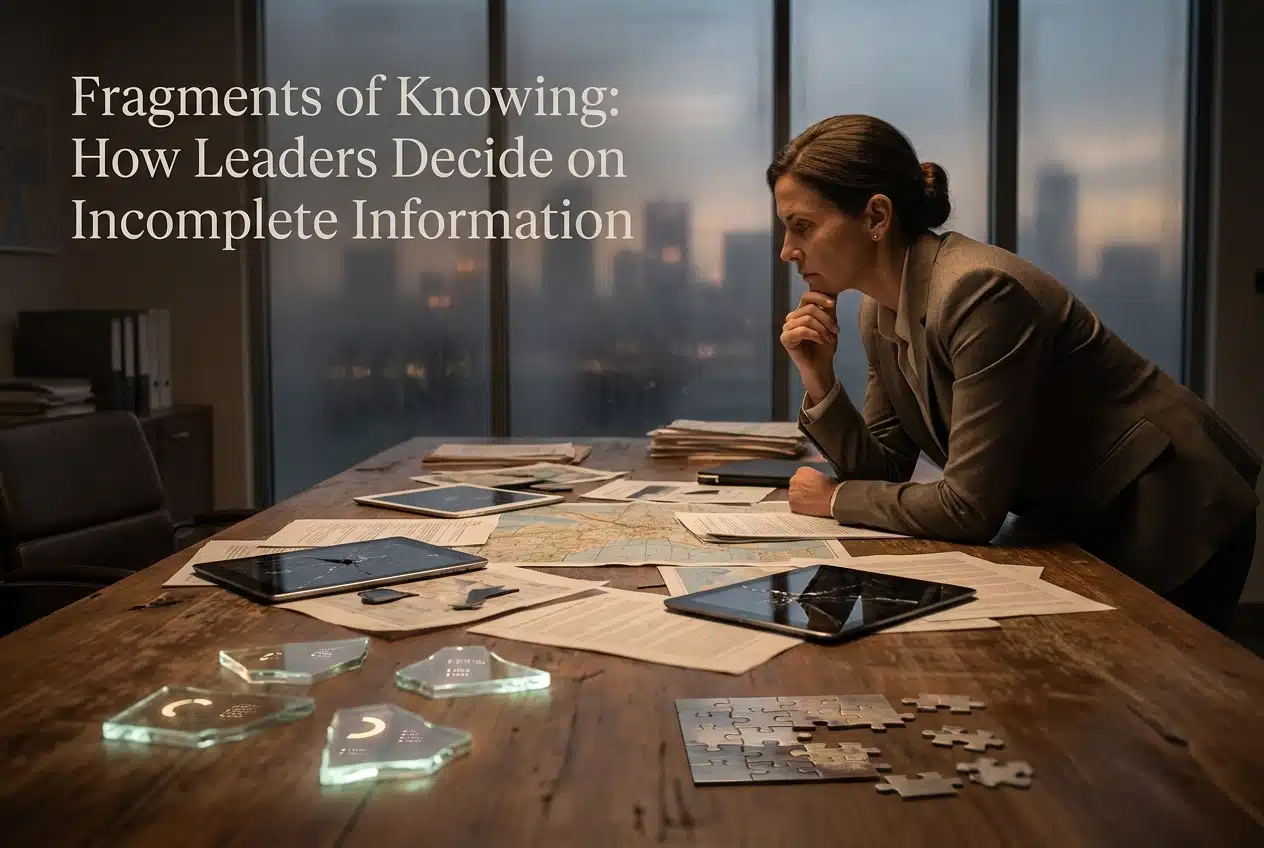
Every major decision a leader makes happens in the dark. Not complete darkness, but the dim, shifting light of partial information, competing priorities. Time pressure that rarely waits for certainty. The question is never whether you have enough data. You never do. The question is what you do with what you have.
The concept of fragments of knowing captures this reality. The scattered, incomplete pieces of insight that leaders must assemble into coherent action. Understanding how this process works is not just intellectually interesting. It is practically essential for anyone responsible for guiding teams, organisations, or strategy.
In this analysis, we will examine how effective leaders navigate uncertainty without being paralysed by it. We will explore the cognitive frameworks they use, the common traps that derail even experienced decision-makers. The disciplines that separate confident action from reckless guessing. Whether you lead a small team or a complex organisation. The ability to decide well on incomplete information is one of the most consequential skills you can develop. What follows is a clear-eyed look at how that skill actually works.
Naming the Condition: What Fragments of Knowing Actually Means

There is a meaningful difference between not knowing something and knowing it partially. Simple ignorance is an absence. You recognise the gap, you can name it, and you can decide how much it matters before you act. Fragmented knowing operates differently and more dangerously. You possess real information, enough to feel oriented, enough to feel confident. That partial picture generates the illusion of sufficient understanding. The fragments you hold become a lens that focuses your attention on what you can see. While rendering invisible everything beyond the frame. As The Uncertainty Project’s analysis of the Rumsfeld Matrix makes clear. The true hazard is rarely the absence of data; it is the false confidence that incomplete data actively produces.
This is where the concept of anti-knowledge becomes useful. Anti-knowledge is not simply a neutral gap in what a leader knows. It is the presence of an unknown that warps judgment, shapes decisions, and produces outcomes the decision-maker cannot account for because the distortion is invisible from the inside. The School of Knowledge’s breakdown of the Rumsfeld Matrix captures the behavioural mechanism precisely. Under conditions of uncertainty, most people skip the discipline of identifying what they do not know. Focusing exclusively on what they explicitly do know. Anti-knowledge is not passive. It acts on decisions before anyone notices it is present.
What makes this condition especially significant is that it is universal, not exceptional. Decision-makers rarely have access to complete information at the moment they must make senior decisions. The organisation is still moving, the environment is still shifting. Decision-makers cannot access the data needed to resolve the uncertainty before they must act. This is not a failure of leadership capability. It is the normal operating condition of anyone making consequential decisions inside complex systems. US intelligence agencies, NASA, and the Department of Defence have each formalised frameworks for working under precisely these conditions. Not because their leaders are incompetent, but because incomplete information is the structural reality of high-stakes environments.
The asymmetry that makes fragments genuinely hazardous follows from this. Anti-knowledge will derail fragile efforts more readily than knowledge will help them. A large visible gap can be planned around; a small invisible one cannot. The cost of unknown unknowns is therefore disproportionate to their apparent size. Which means leaders who rely on confidence built from partial information are systematically underestimating the risks they face.
The argument this analysis develops is not that uncertainty can or should be eliminated. The task is more precise and more demanding. To build a conscious, practised relationship with the fragments you hold, to name the gaps you can see. And to develop the organisational capacity to surface what you cannot yet see. Epistemic humility of this kind is not a soft leadership virtue. It is a structural discipline, and understanding why it matters begins with naming the condition accurately.
Possession Versus Practice: Two Ways of Holding What You Know
In 1999, Scott Cook and John Seely Brown published what would become one of the most cited frameworks in organisational knowledge theory. Accumulating 2,876 citations across decades of research. Their central distinction is deceptively simple but carries significant weight for how leaders interpret the information they act on. An epistemology of possession treats knowledge as a fixed asset: something you acquire, store, and carry into situations. An epistemology of practice treats knowing as something you do, enacted through interaction, observation, and context. The difference is not merely philosophical. It shapes how confidently a leader acts on what they think they know. And how quickly they notice when what they know is incomplete.
Why Possession Thinking Amplifies Fragmentation Risk
The possession model quietly dominates most leadership cultures, yet leaders rarely acknowledge its risks explicitly. When leaders treat knowledge as something they possess, they seldom test it against present conditions. A leader who believes they understand their team’s performance, their market’s direction, or their organisation’s culture is less likely to ask the next question. Does what I know actually match what is happening right now? This is precisely the mechanism through which fragments of knowing become dangerous. The leader is not lying to themselves. They are simply operating within a model that does not build in the verification step. Research on leadership decision-making consistently identifies overconfidence as one of the most persistent cognitive hazards in high-stakes environments. And possession framing provides its structural foundation.
How Practice Epistemology Reframes the Problem
The practice model changes the task. If knowing is something you do rather than something you hold. Then acting on partial information is not a failure of preparation; it is a prompt to keep updating. Leaders oriented toward knowing-as-action treat every conversation, every piece of feedback, and every unexpected outcome as new data to incorporate. A 2025 peer-reviewed study on nurse managers’ strategies for knowledge utilisation in acute care settings illustrates this directly: effective knowledge application in high-pressure environments was not about possessing the right expertise in advance, but about deploying it responsively in context. The practice model better equips leaders to work with partial information because it encourages them to continually improve their understanding rather than defend conclusions they have already reached.
The Cultural Mechanism That Keeps Possession Thinking in Place
Organisational culture does not sit neutrally between these two models. Hierarchies that reward certainty and penalise visible uncertainty actively push leaders toward possession framing. They do so most forcefully at exactly the moments when complexity is highest. A leader who admits uncertainty risks appearing unqualified. But organisations reward leaders who project confidence with credibility, regardless of whether their fragments of knowing justify that confidence. This cultural dynamic compounds the fragmentation hazard rather than correcting it.
The practical question for any leader is direct. When you make a decision, are you assuming you have the knowledge you need? Or are you actively testing what you know against what the system around you is showing you? Those two habits produce fundamentally different outcomes, and the gap between them widens considerably when the information available is incomplete.
The Hierarchy That Breaks Down Under Pressure
Organisational learning literature has given us a remarkably durable model for understanding what we actually hold when we think we know something. The DIKW pyramid identifies four distinct constructs: data, information, knowledge, and wisdom. Each level is not simply more of the previous one; each enables a qualitatively different type of action. Data, the foundation, enables recording. It is raw, observed fact without inherent meaning. Information organises data to answer who, what, when, and where, enabling orientation.
A leader working at the information level can identify what is happening and locate it in time. Knowledge integrates information with experience to answer how, enabling genuine diagnosis and planning. A leader operating at the knowledge level understands mechanisms, can anticipate consequences, and can reason about causes. Wisdom, the apex, applies knowledge with judgment to understand why. Enabling what the literature calls wise action: choosing the right course given competing values, long-term consequences, and contextual complexity. Critically, each layer cannot exist without the one beneath it. Skipping layers does not make the upper layers accessible. It simulates them.
The Bypass That Looks Like Thinking
This is precisely where the hierarchy breaks down under pressure. The failure mode is not ignorance of the model; it is the bypass. Under time pressure, the brain accelerates heuristic shortcuts, producing the sensation of knowledge and wisdom without the underlying integration work having taken place. As the DIKW research literature directly cautions. “The trick is to do it intentionally, and not allow our brains’ penchant for heuristics to climb the pyramid for us.” Leaders act on data or information while believing, in good faith, that they are acting on knowledge. The wisdom layer is not merely abbreviated; it is skipped entirely. The jump from information to action is not a compression of the hierarchy. It is an abandonment of it.
Wisdom Is a Skill, Not a Characteristic
The assumption embedded in most leadership development is that wisdom accumulates with seniority, that it is a trait you acquire rather than a capacity you build. That assumption is incorrect and costly. Wisdom, defined operationally, is the capacity to judge and simplify complexity in order to enable action. It requires deliberate contextualised practice, not simply the passage of time. Most leadership programmes train people to move faster through information, optimising orientation rather than integration. They build analytical confidence without building the synthetic capacity that transforms information into genuine knowledge, or knowledge into sound judgment. The academic conversation has begun to acknowledge this gap explicitly. Recent scholarship looking beyond the standard knowledge hierarchy signals that the field itself recognises wisdom as an under-theorised and under-developed layer in leadership practice. It is a learnable skill. Most organisations simply do not teach it.
Where the Fragments Accumulate
Several structural forces conspire to hold knowledge fragments at the data and information levels without allowing them to integrate upward. Information overload presents the most obvious challenge. Leaders spend their time processing what is happening around them, leaving little time to synthesise why events are occurring or what they mean over time. Meeting culture compounds this. Reporting cycles present organised data as if it were knowledge-level insight. A 30-minute dashboard review collapses the analysis and synthesis stages into a single moment, skipping the synthesis entirely. Cognitive load strips context, and context is the essential ingredient that separates information from knowledge. High-pressure environments are, by design, low-context environments. Additionally, bias introduced at the data-gathering stage does not stay contained. It propagates upward through every level of the hierarchy, corrupting knowledge and judgment invisibly, until real-world consequences expose it.
A Diagnostic Question Worth Asking
Before any significant decision, leaders should confront one question directly. At which level of this hierarchy is the knowledge I am acting on actually sitting? And what integration work have I done, or skipped, to get here? If you cannot describe the synthesis that moved your information into knowledge, you are acting on information. If you cannot articulate the judgment you applied about values, consequences, and context, you have not reached the wisdom layer. This is not a philosophical exercise. It is a practical discipline. People rarely fail to see the fragments of knowledge that drive poor decisions; they simply fail to examine them. This question makes them visible before the cost of the decision makes them undeniable.
Four Forces That Corrupt Fragmented Knowledge
Research on leadership decision-making consistently identifies four forces that corrupt judgment when information is incomplete. The nature of knowing itself, cognitive limitations, groupthink, and ethical distortions. These are not separate problems that appear one at a time. They interact, amplify each other, and tend to accelerate precisely when leaders are under pressure to act on fragments. Understanding how each force operates is the first step toward building decision systems that account for them.
Cognitive Limitations Are Structural, Not Personal
The most common misreading of cognitive bias is treating it as a character flaw, a sign that a leader is careless or insufficiently rigorous. The evidence points in a different direction. Confirmation bias, the availability heuristic, and anchoring are not aberrations in human judgment; they are features of it. Daniel Kahneman’s foundational research, developed across decades and formalised in work with Amos Tversky, demonstrated that these patterns activate automatically, operating below conscious awareness and without deliberate invitation.
This matters enormously when knowledge is fragmented. Confirmation bias does not wait for leaders to consciously dismiss contradictory information. Instead, it filters incoming fragments before they evaluate them, causing confirming evidence to appear more credible and disconfirming evidence to seem less relevant. The availability heuristic means that the fragments a leader can most easily recall, typically the most recent, the most emotionally charged, or the most vividly communicated, carry disproportionate weight in judgments about probability and risk. Anchoring means that the first substantial piece of information a leader receives shapes all subsequent interpretation, even when later fragments contradict it. Under conditions of full information, these biases are partially offset by the sheer volume of evidence. Under conditions of fragmented knowing, they dominate.
Groupthink as a Knowledge-Compression Mechanism
When Irving Janis first described groupthink in 1972, he was studying how cohesive, capable teams arrived at catastrophic decisions. His central finding was not that groups are less intelligent than individuals. It was that group processes, specifically the drive toward consensus and the social cost of dissent, actively suppress the information fragments that would complicate the dominant view.
This is groupthink understood as a knowledge-compression mechanism. When a team reaches agreement quickly, it creates the appearance of shared knowledge while actually narrowing the informational base that the decision rests on. The fragments that survive the consensus process are those that confirm what the group already believes. Leaders often discard the very fragments that would have introduced the necessary friction, frequently without recognising or explicitly rejecting them. Subsequent organisational research has reinforced Janis’s original insight: the problem is not disagreement between team members but the structural suppression of the conditions that would allow productive disagreement to surface.
Hierarchy as an Information Filter
Organisational failures in complex systems rarely stem from a single technical error or a single poor decision. The epistemological grounding of strategic leadership research makes clear that the more consequential failures emerge from subtler psychological and organisational processes that erode collective judgment over time. Chief among these is the way hierarchical communication patterns filter information before it reaches decision-makers.
In hierarchical structures, information travels upward through layers of interpretation. At each layer, people summarise, contextualise, and edit fragments of information to align with what they believe the layer above wants to hear. The leader at the top receives not raw fragments but curated narratives, and the curation process systematically removes the ambiguity, contradiction, and uncertainty that would most improve decision quality. The Columbia Space Shuttle accident investigation identified exactly this pattern: critical safety concerns were present in the organisation but did not reach the people with authority to act on them.
Designing Around Error Rather Than Out of It
This leads to a reframing that has significant implications for how leaders understand their role. Research published in the Colombian Journal of Military and Strategic Studies argues that error is an intrinsic property of complex decision systems. It cannot be eliminated through better processes or better intentions. It must be designed around. This is not a counsel of despair; it is a structural insight that redirects leadership energy from prevention to architecture.
A leader who understands fragments of knowing does not pursue the elimination of cognitive bias, consensus pressure, or hierarchical distortion as personal achievements. Instead, leaders build systems that make fragment misreading more visible and easier to correct. They create structured mechanisms for dissent, conduct pre-mortem analyses, establish multiple independent information channels, and explicitly review what decision-makers excluded from a decision as well as what they included. The role shifts from error-preventer to system-architect, which is both more honest about human limitations and more effective in practice.
AI and the New Generation of Knowledge Fragments
The forces examined in previous sections, fragmented knowing, the possession model, the DIKW hierarchy under pressure, and the four corrupting forces on judgment, have all existed within a largely human epistemic environment. Leaders received incomplete information from other people, from imperfect processes, from organisations with structural blind spots. The fragments were recognisable as fragments. AI introduces something categorically different: outputs that do not feel provisional, that arrive formatted as conclusions, and that carry the surface authority of systems outperforming human experts on PhD-level benchmarks. According to the 2026 AI Index Report from Stanford HAI, 88% of organisations have now adopted AI, and frontier models are meeting or exceeding human baselines across multimodal reasoning, scientific problem-solving, and competitive mathematics. The knowledge fragment has been industrialised.
The Hazard Is Structural, Not Incidental
What makes AI-generated fragments distinctively dangerous is not that they are occasionally wrong. Every information source produces error. The hazard is that AI outputs project an appearance of precision that suppresses a leader’s natural epistemological caution before the leader even evaluates the content. A probabilistic model summarising market conditions or synthesising competitor intelligence does not announce its uncertainty; it presents a paragraph. It uses declarative sentences. It offers no hesitation markers, no caveats about data provenance, no signal that what has just been delivered is a weighted estimate drawn from a training corpus that may be months or years out of date.
Anti-knowledge, the presence of something unknown and undetected, becomes exceptionally difficult to identify when the container it arrives in looks indistinguishable from verified analysis. Performance improvements compound the problem: one leading coding benchmark saw scores rise from 60% to near 100% in a single year, reinforcing the perception that AI outputs are moving steadily toward reliability rather than existing in a permanent zone of qualified confidence.
The Possession Model, Perfected and Weaponised
Earlier sections examined Cook and Brown’s distinction between knowing as possession and knowing as practice. AI outputs represent the possession model at its most extreme. A leader who asks a system to synthesise strategic options and receives a structured response has bypassed every enactive element that matters: the process of reading across contradictory sources, the friction of deciding what counts as evidence, the tacit recalibration that happens when a preliminary conclusion meets contextual reality.
Research on organisational knowledge foundations consistently shows that organisations treating knowledge as infrastructure rather than output pull ahead on AI outcomes and client trust. The distinction is not incidental; it reflects whether the organisation is doing the knowing or simply receiving the packaged result. The synthesis a leader outsources to an AI system is not merely a time-saving convenience; it is the enactive process through which partial information gets tested and calibrated. When that process is skipped, what remains is a confident-sounding fragment, and the leader may not know what they have lost.
What the New Literacy Demands
Interrogating AI outputs requires the same critical framing leaders would apply to any other partial information source, and then several additional questions beyond that. Who trained this model, on what data, and toward what optimisation target? Industry produced over 90% of notable frontier models in 2025, per the Stanford AI Index, which means the systems most leaders are using were built under commercial incentives that do not necessarily align with the epistemic caution those leaders need. Beyond provenance, leaders should be asking what the model structurally cannot know: real-time developments, local context, tacit organisational history, and the edges of its training distribution are all invisible from the output layer. False-positive rates in purpose-built AI knowledge systems run between 15% and 40% depending on architecture, a figure that, transposed to executive decision contexts where no equivalent validation workflow exists, represents a significant and largely invisible fragmentation risk.
An Organisational Culture Problem, Not a Personal Skill Gap
Individual AI literacy, while necessary, is insufficient on its own. When teams normalise treating AI recommendations as endpoints rather than inputs, the fragmentation problem scales beyond what any individual’s critical habits can address. At 88% organisational adoption, AI is now a collective epistemic environment. If the majority of a team’s research, synthesis, and recommendation activity passes through systems treated as authoritative, the organisation’s shared knowledge base becomes constituted substantially by unvalidated fragments, each one carrying hidden uncertainty that no single member has the context to detect. The International AI Safety Report 2026, representing the largest global collaboration on AI safety to date and backed by over 30 countries, frames AI risk explicitly as a governance and institutional challenge, not a matter of individual proficiency. Leaders who understand this distinction are not simply better users of AI tools; they are the architects of the epistemic culture their organisations will navigate by.

Anti-Knowledge as a Leadership Competency
Recognising what you do not know is not the same as being humble. Humility is a disposition; anti-knowledge awareness is a competency. The distinction matters because dispositions are relatively stable traits, while competencies can be practised, measured, and deliberately strengthened. Anti-knowledge, in this context, refers not to passive ignorance but to the active presence of unknown information that is consequential enough to alter a decision if it surfaced. A leader who is simply humble may acknowledge uncertainty in general terms. A leader with genuine anti-knowledge literacy can identify which specific gaps are load-bearing before committing to a course of action. That precision is what separates the two, and it is what makes this a skill worth developing systematically.
The Pre-Decision Knowledge Audit
One practical entry point is a structured pre-decision audit built around four questions. First: what do I know, and what is its source? This forces a distinction between firsthand observation, second-hand reporting, and assumption presented as data. Second: what am I assuming without verification? Many consequential decisions rest on premises that have never been tested, simply inherited from previous decisions or cultural defaults. Third: what would I need to know to change my conclusion? This question identifies the actual threshold for revision and surfaces whether a leader is genuinely open to contrary evidence or is effectively committed regardless. Fourth: what is the cost if my key unknown turns out to matter? This final question converts abstract uncertainty into operational risk, giving anti-knowledge a weight that can sit alongside other decision variables.
Applied consistently before high-stakes decisions, this four-question structure builds the habit of mapping knowledge fragments rather than concealing them under confidence.
Why Seniority Works Against This Skill
This competency is harder to develop precisely where it is most needed: at senior levels. The organisational dynamics that accompany seniority systematically suppress the feedback that would otherwise surface knowledge gaps. Deference from direct reports, faster consensus in the room, and reduced willingness to challenge stated positions all reduce the quality of information a senior leader actually receives.
Research indicates that only 2% of people who believe they are self-aware actually are, a gap that organisational hierarchies tend to widen rather than close. The problem is not that senior leaders become less intelligent; it is that the signals they depend on become progressively less accurate. When 77% of organisations already report that leadership capability is lacking, the compounding effect of seniority-induced information insulation makes anti-knowledge literacy a structural, not merely personal, challenge. Traditional development programmes have not helped: most have focused narrowly on technical skills and strategic frameworks, leaving the internal diagnostic capability that this competency requires largely unaddressed.
Anti-Knowledge as a Team Design Variable
The practical implications extend beyond individual practice into team design. When leaders model explicit uncertainty, naming what they do not know rather than managing the appearance of confidence, they create permission structures that change what teams feel safe surfacing. Research into intrapersonal and interpersonal leadership competencies confirms that the internal regulatory behaviour of a leader directly shapes the interpersonal environment of the team. Knowledge fragments that would otherwise be filtered out, withheld as too uncertain to mention, or quietly absorbed into consensus positions become speakable when the leader has already publicly named their own gaps. This is how anti-knowledge awareness functions as an organisational mechanism, not just a personal one.
Literacy, Not Confession
Anti-knowledge literacy should be understood as a critical learning capability at the organisational level, not a personal admission of weakness. The two most neglected leadership competencies in current practice are self-awareness and the capacity to sit with uncertainty, both of which underpin anti-knowledge literacy directly. Learning organisations that integrate knowledge across individual, group, and organisational levels simultaneously, as Senge’s model requires and Nonaka and Takeuchi’s knowledge creation work reinforces, are structurally better positioned to surface and use knowledge fragments before they become liabilities. The goal is not leaders who perform doubt. It is organisations where the honest mapping of what is known, partially known, and not yet known becomes a routine feature of consequential decision-making, embedded in practice rather than confined to individual character.
Working With What You Have: Principles for Fragment-Aware Leadership
Fragment-aware leadership is not a synonym for cautious leadership. The distinction is critical. Slowing down every decision to audit your knowledge base is not the goal; calibrating your speed and confidence to the actual quality of what you hold is. Leaders who conflate epistemic care with hesitation tend to overcorrect in ways that create different problems: bottlenecks, missed windows, team disengagement. The real objective is to make the epistemological work visible, not to stop the clock. When you can see clearly what you know, what you partially know, and what remains genuinely opaque, you are in a position to move at appropriate speed rather than defaulting to false certainty that feels like confidence but functions as risk.
Three Principles for Navigating Fragments in Practice
Name your fragments explicitly before deciding. Most decision processes begin with the information you have, not an honest inventory of the information you lack. A practical correction is to treat the pre-decision moment as an epistemic audit: what are we treating as known that is actually assumed? What fragments are we filling in with pattern-matching rather than evidence? This is not a lengthy process; it can be as brief as a structured two-minute prompt at the start of a decision conversation. The discipline is in making the gaps visible before you reason across them rather than discovering them only when outcomes go wrong.
Build knowledge integration into team rhythms, not one-off exercises. A 2026 review of 278 scholarly works on adaptive leadership found the field itself remains conceptually fragmented and theoretically underdeveloped, which means practitioners cannot rely on pre-packaged frameworks to do this work for them. Integration must become habitual: regular team practices that surface what different members are holding, where interpretations diverge, and how partial pictures are being assembled into collective understanding. Teams that treat knowledge integration as a recurring discipline rather than a crisis response build substantially more robust decision capacity over time.
Design decision processes that assume error rather than penalise it. Error is intrinsic to complex systems operating on incomplete information; it should be designed around, not designed out. This means building review points, creating low-cost reversal options where possible, and normalising the discovery of new fragments after a decision has been made. Penalising error drives fragments underground, where they compound quietly into larger failures.
The Wisdom Layer: Articulating the Why Behind Simplification
Wisdom, in the DIKW sense explored earlier in this analysis, is the capacity to simplify complexity in a way that enables action. But there is a dimension of this that most leadership development frameworks underemphasise: the difference between doing the synthesis and being able to articulate why you reduced complexity in a particular direction. Leaders routinely simplify, but leaders who can explain their simplification reasoning are operating at a meaningfully higher level. They are not just acting on a judgment; they are making the epistemological scaffolding of that judgment visible to others. This is a trainable capacity, and it develops through deliberate practice in synthesis, not through accumulating more information. Notably, research on self-aware leadership finds that the acknowledgement of not knowing is itself a prerequisite for this kind of wisdom, not a gap to be closed before wisdom becomes possible.
For managers moving into roles where the volume of incoming fragments increases sharply, these habits do not develop automatically. The transition from bounded information environments to structurally incomplete ones is precisely where the gap between confidence and calibrated knowledge becomes most dangerous. The leadership frameworks and evidence-based resources at DarrenWalley.com are designed to build these habits systematically, providing the scaffolding for leaders navigating exactly this kind of transition.
The final reframe is the one that holds everything together. The fragments you hold are not a problem that must be resolved before leadership can begin. They are the permanent condition within which leadership actually happens. Every leader, at every level, is working from a partial picture. The difference between leaders who navigate this well and those who do not is not the completeness of their information; it is the quality of their relationship with incompleteness. That relationship can be developed. The skill is in using what you have, wisely.
Conclusion: The Leader Who Knows What They Don’t Know
Fragments of knowing are not a failure of preparation. They are a structural condition of leadership at scale, and the leaders who perform most consistently are those who have developed a practiced, honest relationship with incomplete information rather than a reflexive confidence in what they believe they hold.
Three principles from this analysis deserve to stay with you. Before major decisions, audit what you actually know using the four-question framework: what is the source, how recent is it, what assumptions are embedded in it, and what would change your position. Second, model explicit uncertainty openly with your team. When you name what you do not know, you create organisational permission for others to surface what they do. Third, treat AI outputs as high-confidence fragments, useful, sometimes remarkably accurate, but probabilistic by design and unverified by default.
The next time you are about to act with confidence, pause. Ask not just what you know, but what your knowing is made of. Then ask what the gap might cost you.
Leave a Reply