The rules of leadership have always evolved, but rarely with the velocity and weight we are witnessing today. Disruption is no longer an occasional challenge to navigate around; it is the permanent terrain. And yet, many executives, managers, and organisational architects are still operating from playbooks written for a world that no longer exists.
This analysis cuts through the noise to examine what leadership actually demands in this moment. Not as an abstract ideal, but as a set of concrete, high-stakes competencies. That separate those who drive outcomes from those who simply occupy positions of authority. We will explore the cognitive, relational, and strategic dimensions that define effective leadership under genuine pressure. Drawing on behavioural research, organisational data, and real-world patterns that too often go unexamined in mainstream discourse.
If you lead people, influence decisions, or shape culture at any level, what follows is not a motivational reframe. It is a rigorous look at the gap between conventional leadership assumptions and what the evidence actually supports. Prepare to interrogate what you think you know.
Leadership Is at an Inflection Point, and Most Organisations Are Facing the Wrong Direction
Microsoft’s 2026 Work Trend Index, drawing on 20,000 workers across 10 countries. Delivers a finding that should fundamentally reframe how organisations think about AI and leadership. As AI agents absorb execution tasks, human agency expands. The capacity for judgment, orchestration, and strategic thinking grows. But most organisations are not structured to capture that expanded potential. The gap between what AI makes possible and what organisations actually realise is not a technology gap. It is a leadership and design failure.
The evidence on this point is direct. Organisational factors, specifically culture, manager support, and talent practices, account for roughly twice the reported AI impact of individual effort alone. This matters enormously for how organisations should be investing their attention. No individual leader, however capable or motivated, can outperform a structurally broken environment. The system shapes outcomes far more decisively than the person operating within it.
Yet the dominant organisational response has been to treat this as a spending problem rather than a design problem. 87% of organisations plan to increase AI investment in learning and development, and the intent is genuinely high. The problem is that the same evidence from the full 2026 report shows organisations are structurally unprepared to translate that investment into better leadership outcomes. MIT research examining 300 public AI deployments found that 95% of enterprise generative AI pilots produced no measurable P&L impact. The bottleneck was not the model. It was the organisational learning gap surrounding it.
This tension between high investment intent and structural unpreparedness is not a technology problem. Conflating the two, leads organisations to keep buying tools while the real bottleneck – unclear decision rights, absent governance, and cultures that never redesigned work in the first place, goes unaddressed. This piece uses the Microsoft findings, the human-centred skills shift. And the emerging Frontier Firms concept to build a precise, evidence-grounded argument about what leadership genuinely requires right now.
AI Investment Is Not the Same as AI-Ready Leadership
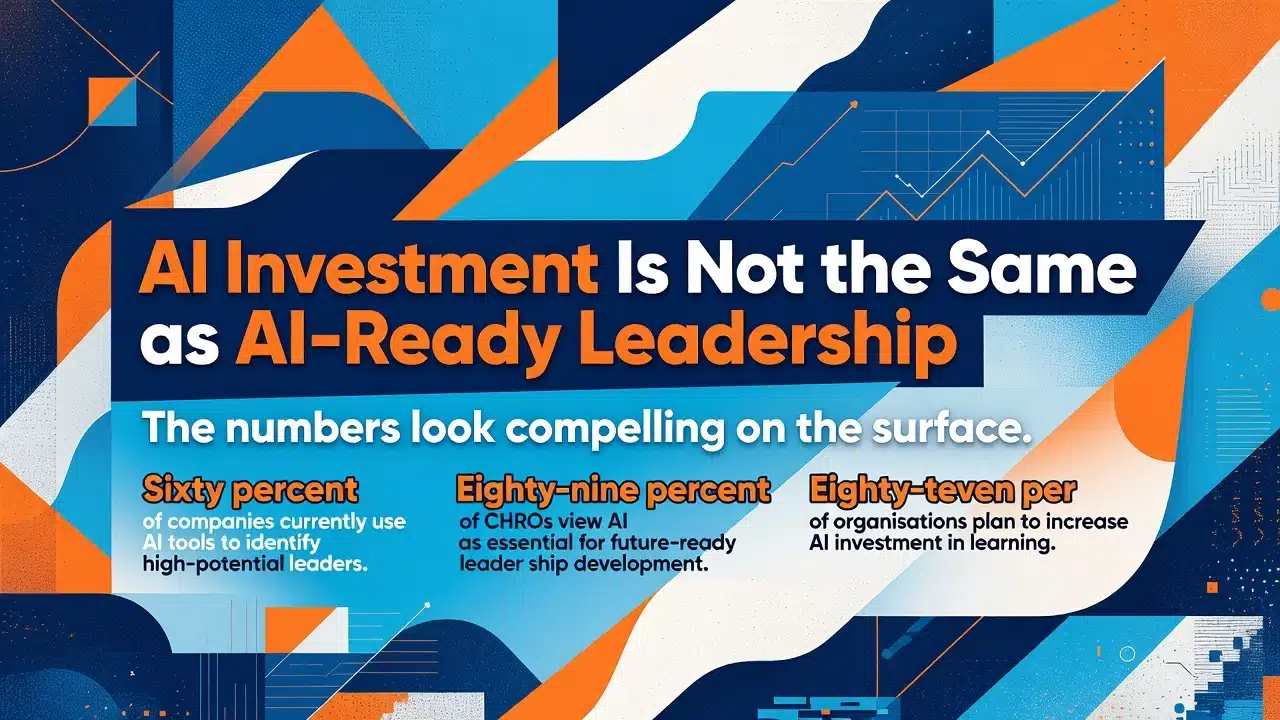
The numbers look compelling on the surface. Sixty per cent of companies currently use AI tools to identify high-potential leaders. Eighty-nine per cent of CHROs view AI as essential for future-ready leadership development. Eighty-seven per cent of organisations plan to increase AI investment in learning and development. Taken together, these figures suggest an industry moving with urgency and purpose. What they do not tell you is whether any of it is working.
The more granular data does not settle the question; it deepens it. AI-powered development programmes report 35% higher completion rates and 40% faster skill acquisition than traditional methods. These are the statistics that appear in enterprise sales conversations, and they are not fabricated. But they are activity metrics, not outcome metrics. Completion rate measures whether a leader finished a programme. Skill acquisition rate measures whether they retained content at a faster pace. Neither metric measures whether their leadership improved. Whether their teams perform differently, or whether they are better equipped to navigate the specific conditions that the current environment is generating. Over half of companies report limited or no measurable value from AI adoption so far. The Davos 2026 consensus attributed this not to technology failure but to insufficient preparation. Unclear role redesign, weak skills pathways, and missing change infrastructure. The tools are present. The readiness is not.
The ROI figures circulating in enterprise leadership development sales materials deserve direct scrutiny. A 424% ROI claim, when it appears in vendor positioning, functions as a justification mechanism, not an interrogation tool. ROI framing asks: did this investment return more than it cost? It does not ask: was this the right investment? It does not ask: are we developing the skills the environment actually demands? These are structurally different questions, and the framing choice has consequences. Organisations that evaluate their leadership development programmes through ROI metrics are, by definition, optimising for evidence that supports continued investment rather than evidence that challenges the direction of that investment.
This is where the analysis becomes uncomfortable. BCG’s 2026 framing of the CHRO role is not incremental adaptation; it is full reinvention. The Microsoft 2026 Work Trend Index identifies the defining leadership responsibility of this period as rearchitecting work: actively deciding what humans and AI each do. The skills required to do that well are not the skills most AI-powered development programmes are currently targeting. Programmes optimised for speed and scale are building technical fluency and functional competence. The environment is demanding something harder to measure. The capacity to think clearly, decide wisely, and lead human-AI teams through sustained uncertainty.
Spotting an AI-ready leader is increasingly recognised as a distinct diagnostic challenge, separate from whether a leader has completed AI training. The distinction matters. Organisations are developing people to use better tools. The question they are not asking with sufficient rigour is whether they are developing people to think more effectively in an environment where tools now do more of the execution. Those are not the same objective, and conflating them is costing organisations the very capability they believe they are building.
Organisational Culture Is the Real AI Bottleneck, Not the Technology
The Microsoft 2026 Work Trend Index finding that organisational factors. Specifically, culture, manager support, and talent practices account for twice the reported AI impact of individual effort alone. And is one of the most consequential data points in the current leadership landscape. It is also, remarkably, one of the most underutilised. Most organisations continue to frame AI adoption as a technology deployment problem. Thus something to be managed by IT, governed through procurement, and measured by licence utilisation. This framing is not just incomplete; it is systematically expensive. Organisations that approach AI this way are leaving the majority of their potential AI benefit unrealised. Not because the technology is failing but because the culture in which it operates is never examined.
The evidence from multiple directions is consistent. AI adoption is a people challenge before it is a technology one, and the organisations that recognise this earliest are the ones pulling ahead. Research from the University of California illustrates the scale of the cultural variable with striking clarity: when employees were asked whether they would share an innovation idea if it meant doing different work, only 37% agreed. When the same question was reframed around doing better, more meaningful, more humane work, 87% agreed. The technology, the outcomes, and the people were identical across both scenarios. Only the framing changed, and it produced a 50-percentage-point shift in willingness to engage. Leaders who treat AI rollout as an IT project rather than a human change programme are not just making a methodological error. They are starting with the wrong framing and then wondering why adoption stalls.
Manager behaviour is the primary cultural variable, and it operates in ways that most leadership development programmes do not yet address. Leadership, not technology, is now the AI bottleneck, and the bottleneck is visible most clearly in how managers engage with AI-generated outputs day to day. A manager who accepts AI outputs without interrogation signals to their team that critical evaluation is optional. A manager who models active questioning, who asks what assumption this output is resting on, what the AI cannot see in this data, what we would conclude if this output were wrong, creates a team culture of genuine AI fluency. The distinction matters enormously because surface compliance with AI tools and genuine AI capability produce radically different outcomes. Compliance produces faster versions of the same thinking. Fluency produces better decisions.
Psychological safety is directly implicated in this dynamic, though it is routinely treated as a peripheral concern. Teams operating without psychological safety default to using AI to generate outputs that will be accepted. Not outputs that might surface uncomfortable conclusions or challenge the manager’s preferred direction. The result is that AI amplifies existing cultural patterns. In a culture of compliance, AI accelerates compliance. In a culture of genuine inquiry, AI amplifies insight. This is not a soft skills argument. It is a structural argument about how cognitive environments shape the quality of decisions.
The practical implication for leaders is direct. Auditing culture before launching capability programmes is not a delay; it is the prerequisite for those programmes producing any lasting return. A development programme delivered into a culture of compliance will not transform that culture. It will replicate compliance at greater speed, with better-trained people who have learned to use AI tools to produce more polished versions of whatever answer the system already expects.
Rearchitecting Work Is Now a Core Leadership Responsibility
Microsoft’s 2026 Work Trend Index names “rearchitecting work” as one of the defining leadership responsibilities of this moment. The active, deliberate process of deciding what humans do, what AI agents do. And where those boundaries sit within a team or organisation. This is not a rebranding of workforce planning. It is a structurally new cognitive task that most leaders have never been trained to perform. The gap between what the role now demands and what most leadership development has actually built is significant.
The distinction matters because rearchitecting work requires a different kind of thinking from managing people. Managing people draws on relational skills, performance coaching, motivation, and accountability. Rearchitecting work demands systems thinking: the ability to map a workflow, identify where human judgment creates irreplaceable value, determine where AI execution creates genuine leverage without degrading quality or creating ethical risk, and then make a defensible architectural decision about the division of labour. Leaders must hold two questions simultaneously. The first is where human presence, ethical accountability, and relational intelligence are not optional features but core requirements. The second is where AI agents can execute at speed and scale without that human layer becoming a bottleneck in ways that actually diminish outcomes.
The World Economic Forum’s Future of Jobs Report 2025 projects that 39% of workers’ core skills will change by 2030. That figure applies equally to leaders themselves. Most senior leaders built their careers in environments where the fundamental unit of work was a human being completing a task. Their development focused on selecting, developing, motivating, and holding people accountable. It did not focus on designing the real-time division of labour between human and artificial agents. And it did not prepare them to make those decisions iteratively as AI capabilities evolve. Deloitte’s 2026 Global Technology Leadership Study frames the shift explicitly. Describing a new mandate in which technology leaders move from operators to orchestrators. That framing captures the structural nature of the change: orchestration requires system design, not just execution management.
The organisations already doing this well are what the Microsoft 2026 Work Trend Index calls “Frontier Firms.” These are organisations that have moved beyond using AI as a productivity add-on and are actively redesigning their operating models around it. Their leaders are making architectural decisions proactively. Which means they are building competitive advantage before their slower-moving counterparts recognise the game has changed. The firms still treating AI as a departmental tool are, in effect, letting their operating model ossify while the environment continues to shift beneath them.
The critical implication for leaders is that rearchitecting work is not a one-time restructure. Leadership capability in 2026 now requires sustained adaptability and the willingness to revisit assumptions as AI capabilities change quarter by quarter. An architectural decision that made sense in early 2025 may already be suboptimal. Leaders who treat the human-AI division of labour as a fixed configuration, rather than a live variable, are not managing a stable system. They are managing an increasingly outdated one.
Human-Centred Skills Are Not Soft Skills Anymore
Empathy, emotional intelligence, and mental health awareness have moved from the periphery of leadership capability frameworks to their centre. The organisations that have not yet made this adjustment are not simply behind on a cultural trend. They are misaligned with the structural realities of how value gets created in a leadership role right now. The shift is measurable: organisations are increasingly tracking engagement scores, psychological safety indicators, and wellbeing data alongside traditional productivity metrics because they have recognised that these signals predict performance outcomes. Not just employee satisfaction. A Workday global survey found that 83% of employees believe AI will make uniquely human skills more critical. Not less, which inverts the assumption that automation narrows the premium on human capability. The evidence runs in precisely the opposite direction.
The reason for this shift is structural, not sentimental. As AI absorbs more of the execution layer, the residual value of human leadership concentrates in the capabilities that AI cannot replicate. Relationship-building, ethical judgment, meaning-making, and contextual sensitivity. SIY Global’s analysis of over 300 business reports describes emotional intelligence as “the capacity that keeps people steady enough to learn, adopt new tools, and execute strategy” in a volatile environment. This framing matters because it repositions EQ not as a quality-of-life enhancement for teams. But as the operational substrate that makes everything else, including AI adoption, function. When a Fortune 500 organisation positioned AI as a replacement rather than an augmentation tool, the result was not efficiency. Trust collapsed, productivity declined, and attrition rose. Human-centred leadership is what prevents that failure mode.
The persistence of the “soft skills” label in capability frameworks is itself a liability. Leadership training trends for 2026 show that forward-looking L&D functions are integrating EQ development alongside AI fluency. Treating them as complementary investments rather than competing priorities. Organisations that still separate them, filing empathy under optional interpersonal skills while treating technical fluency as core, are building frameworks around a model of leadership value that the operating environment has already made obsolete. Relational intelligence, the ability to understand how trust, communication, and influence move through a system, is now the differentiating capability. Not a supplement to it.
Hybrid and distributed team structures have accelerated this reckoning considerably. When leaders cannot rely on the ambient reinforcement of physical co-location, connection must be built deliberately. Asynchronous communication, outcome-based management, and high-trust virtual environments all require leaders to sustain relational continuity without the informal signals that proximity provides. Slow listening, visible thinking, and bounded vulnerability have become identifiable leadership behaviours in distributed contexts, not soft gestures but functional competencies with direct impact on team cohesion and execution quality.
Inclusive leadership has followed the same trajectory, moving from optional module to core curriculum. Organisations embedding reverse mentoring, psychological safety frameworks, and systemic bias awareness into their leadership programmes are doing so because they have reframed exclusion as an execution risk. Fractured team dynamics, disengagement driven by perceived inequity, and the cognitive overhead of navigating unsafe environments all reduce the capacity available for actual work. Gallup data recorded a drop in manager engagement from 30% to 27% in 2025, a rare decline for a cohort that historically holds steady even under pressure, signalling that the emotional load on leaders has reached a point where it demands a structural response, not a wellness initiative.
Critical Thinking Is the Leadership Capability Most at Risk, and the One That Matters Most
The risk that almost no one in the leadership development industry is naming clearly enough is this. When AI absorbs routine cognitive work, leaders do not simply become less busy. They become less practised. And the capability that atrophies quietly, through disuse rather than any single failure, is the one that matters most when the situation is genuinely ambiguous, genuinely high-stakes, and genuinely without a clean AI-generated answer.
Research from MIT Media Lab, cited by the Harvard Gazette as recently as November 2025, raises the concern that excessive reliance on AI-driven solutions may contribute to cognitive atrophy, a gradual narrowing of the critical thinking capacity that judgment depends on. The mechanism is not dramatic. It mirrors what happened with calculators, with GPS navigation, with any tool that made a cognitive task easier. Capabilities that stop being exercised stop being reliably available under pressure. The MDPI research on cognitive offloading makes the structural logic explicit. AI tools are designed to reduce friction. But friction is precisely the condition under which genuine reasoning capability is built and maintained. When leaders habitually route their thinking through AI outputs rather than through their own analysis, the neural pathways that produce independent judgment get less use, not more.
This is where the current leadership development landscape reveals a significant blind spot. Seventy-two per cent of HR leaders believe AI will be critical for leadership development within three years, and the investment flows confirm that belief. 87% of organisations plan to increase AI investment in learning and development, and the AI leadership development market is projected to reach $3.2 billion by 2027. What that investment is predominantly buying is capability acquisition, new skills, AI fluency, digital literacy, and adaptive learning paths. Almost none of it is oriented toward the metacognitive question of how constant AI exposure changes the quality of leaders’ own reasoning over time. Russell Reynolds Associates has identified this as the defining leadership development gap of the AI era, a structural mismatch between what development investment targets and what leaders actually need to protect.
The personalisation paradox sharpens the problem considerably. Seventy-eight per cent of professionals prefer AI-personalised learning paths over standardised programmes. That preference is entirely rational from an efficiency standpoint. AI-personalised learning delivers 40% faster skill acquisition and 35% higher completion rates. But here is the irony that the industry has not confronted directly. AI-personalised leadership development, optimised as it naturally is for efficiency and completion. May itself accelerate the very erosion it is meant to address. When development removes productive struggle in favour of smooth, frictionless progress. It optimises for the metrics it can measure while quietly degrading the capability it cannot.
BCG’s 2026 analysis moves this from individual concern to enterprise-level strategic risk, arguing that when everyone uses AI, organisations risk losing critical skills at scale. The aggregate effect across a leadership cohort is a fundamentally different and larger problem than any single leader’s cognitive habits. The leaders most likely to generate durable competitive advantage through AI are not those with the greatest AI fluency. They are those who maintain enough critical distance to know when an AI output deserves interrogation, when it should be overridden, and when it should be ignored entirely. That capacity does not emerge from using AI more. It emerges from deliberately, structurally protecting the space to think without it.
Measuring Leadership Quality, Not Just Leadership Activity
The leadership development field has a measurement problem it largely refuses to name. Organisations invest heavily in programmes attended, coaching hours logged, modules completed, and certifications earned, and they treat these inputs as reasonable proxies for whether leadership is actually improving. They are not. They are evidence of activity, and activity is not the same as capability. Gallup research indicates that managers account for up to 70% of the variance in team engagement, yet the measurement infrastructure built around leadership development remains stubbornly input-focused. The organisations carrying the most leadership risk right now are not the ones with too little development activity. They are the ones with too much confidence in what that activity proves.
The problem intensifies sharply in AI-augmented environments, because AI creates new and structurally invisible opportunities for confident incompetence. A leader who uses AI to surface analysis, generate recommendations, and structure communications can appear decisive and assured without having developed the judgment to evaluate whether any of those outputs are actually right. Confidence and competence diverge quietly in this environment. The leader feels capable because the answers arrive quickly and fluently. The organisation sees a leader who projects certainty. Neither the leader nor the organisation has tested the underlying judgment because they have systematically removed the conditions that expose weak judgment, particularly the need to navigate ambiguity without a scaffold.
Genuine leadership competence requires leaders to perform in conditions where AI can assist but cannot provide the answer. Incomplete information, interpersonal tension, conflicting stakeholder interests, and decisions where no amount of prompting produces a clear solution. These are the conditions that separate leaders who have internalised judgment from those who have learned to operate with effective cognitive support. Measuring whether leaders can navigate these conditions requires observation and evaluation that most organisations do not currently build into their development or assessment infrastructure.
The dominant measurement tools, specifically engagement survey scores, 360 feedback, and programme completion data, compound this problem rather than address it. Research cited by Deloitte finds that only 32% of executives believe their performance management systems support quality talent decisions, and 64% of employees consider performance reviews a waste of time. These are not fringe dissenting views; they are the internal verdict of the organisations using these tools. As AI makes it easier to produce polished 360 narrative responses, articulate coaching reflections, and achieve high completion rates across digital learning platforms, the gap between proxy and outcome widens. The evidence of leadership development multiplies. The actual quality of leadership judgment remains untested.
A more rigorous measurement culture asks different questions entirely. It asks what decisions a leader made in the past quarter, how they made them, what information they acted on, and what they were willing to challenge when the consensus pointed the wrong way. It asks whether their judgment held under pressure or whether it shifted with every new input. These questions are harder to score and harder to aggregate into dashboards, but they are the questions that actually predict whether leadership quality is improving. Building a measurement culture around them requires organisations to treat leadership evaluation as an ongoing analytical practice rather than an annual administrative event, and that shift is more difficult than any technology investment. It demands that organisations be willing to find out what their measurement infrastructure has been concealing.
What Leadership Development Actually Needs to Look Like Now
The problem with most leadership development in 2026 is not that the methods are wrong. It is that the operating environment has changed faster than any fixed curriculum can track. Leaders are simultaneously managing sustained organisational change, rising performance expectations, rapid technology adoption, and real capacity constraints, often without the organisational support to make any of them manageable in isolation. A programme designed eighteen months ago was built for a context that no longer fully exists. This is not an argument for abandoning structure. It is an argument for building development approaches that are genuinely responsive to the conditions leaders are actually working in, rather than conditions that were convenient to design for.
Microlearning and just-in-time development offer a practical response to the capacity problem, and they make development more accessible to leaders who cannot dedicate two days to a residential programme. However, the field largely overlooks a significant risk: when organisations break development into bite-sized modules primarily to accommodate busy schedules rather than achieve clear learning objectives, they tend to prioritise knowledge transmission over capability building. They deliver information instead of developing competence.
Leaders do not build capability simply by consuming content. They develop it by reflecting on experience, applying what they learn under pressure, and receiving honest feedback on their performance. Treating information delivery as the primary mechanism for development creates the application gap. A substantial majority of organisations rate their leadership development as ineffective, while much of what people learn in training never transfers into workplace practice.
AI-powered coaching and personalised development paths address part of this problem, and they do so genuinely when deployed well. The finding that organisations using AI for talent development report 40% faster skill acquisition is meaningful, but only under one critical condition: the skills being acquired faster must be the right ones. AI that accelerates the acquisition of compliance behaviours, or reinforces existing cognitive patterns rather than challenging them, does not produce better leaders. It produces faster credentialing. Where AI personalisation earns its keep is in creating more frequent, contextually relevant development moments that connect to the actual decisions a leader is facing, making reflection a practice embedded in the work rather than an event scheduled around it.
The organisations building genuine leadership capability right now do not stand out because they invest more in technology or design more sophisticated programmes. Their culture sets them apart. No development programme, however well-designed, produces better leaders in an environment that rewards compliance, penalises challenge, and treats honest feedback as a performance risk rather than a professional norm. Honest feedback is not a programme feature; it is infrastructure. Without it, development sits on top of a culture that quietly undoes whatever the programme intended.
The work on DarrenWalley.com takes exactly this approach. It equips leaders with the critical thinking and practical frameworks they need to navigate this environment with confidence, challenge prevailing development trends, and determine whether those trends are genuinely fit for purpose.
The Leaders Who Will Define What Comes Next
The evidence is in. The frameworks exist. The question now is whether your organisation will act on what the research is actually showing, or continue investing in the appearance of readiness while the structural gaps compound.
Start with culture, not capability programmes. The Microsoft data is unambiguous: organisational factors account for twice the AI impact of individual effort, which means the highest-leverage intervention available to most organisations is not another development programme. It honestly assesses whether the current culture, manager behaviours, and talent practices support the expanded human agency that AI makes possible. Most are not, and most organisations are not asking the question.
Treat rearchitecting work as a standing leadership responsibility, not a project to complete. The division of labour between humans and AI will keep shifting, and it requires leaders who understand both strategic priorities and the real limits of AI judgment, continuously, not once.
Protect critical thinking actively. Build in deliberate reasoning demands. Measure decision quality and organisational impact, not programme completion. The leaders who will define what comes next are those who remain genuinely competent under pressure, not those who appear most fluent with the latest tools. The gap between organisations that act on this evidence and those that simply follow trends is already widening. Close it.
Leave a Reply