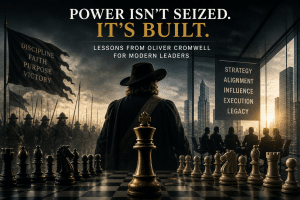

Most people misunderstand power because they fixate on the moment it becomes visible. They look for the speech, the confrontation, the bold move that appears to shift everything at once. History tells a different story. Power is rarely seized in a single act. It is accumulated, structured, and made inevitable long before anyone notices. The rise of Oliver Cromwell during the collapse of the English Civil War is a clear example of how influence is built, not taken. Strip away the violence and period detail, and what remains is a pattern that applies directly to modern leadership, organisational change, and power dynamics. You Don’t Take Power, You Make It Inevitable a Lesson that Oliver Cromwell knew well.
Build Capability Before You Seek Authority
Cromwell did not begin by challenging Parliament. He began by building something that worked better. The New Model Army was disciplined, professional, and consistent in ways other forces were not. It delivered results while others struggled with fragmentation and inefficiency. That is where real power began. Before Cromwell had political dominance, he had operational dominance.
In modern organisations, the same principle applies. Influence does not come from job titles first. It comes from execution. Teams that deliver reliably become indispensable. Individuals who consistently solve problems gain trust. If you want to influence outcomes, you need to be part of something that works when everything else is failing. Without that foundation, authority remains superficial and easily challenged.
Alignment Turns Capability into Power
Execution alone does not create lasting influence. What made Cromwell’s position stronger was alignment. The New Model Army was not just effective; it was unified by belief. Its members were committed to a shared purpose, not just following orders. That belief created cohesion, and that cohesion created loyalty.
Modern leaders often mistake agreement for alignment. Agreement is what happens in meetings. Alignment is what happens when people act without being told. If your team only agrees with you when you are present, you have compliance. If they act in line with the mission when you are not, you have commitment. Real influence comes from building that level of alignment around outcomes, standards, and purpose.
Failing Systems Collapse Themselves
While Cromwell was strengthening his position, Parliament was weakening its own. Internal divisions, slow decision-making, and an inability to resolve key issues created paralysis. The gap between what Parliament was supposed to do and what it actually delivered became increasingly obvious.
This is a pattern repeated in modern organisations. Systems rarely collapse because they are attacked. They collapse because they stop working. Targets are missed, decisions stall, accountability fades, and performance is replaced by narrative. Leaders who understand power do not exaggerate these failures. They allow them to become visible. Evidence is far more powerful than opinion, and once failure is visible, legitimacy begins to erode.
Structure Determines Outcomes
The event known as Pride’s Purge changed the composition of Parliament by removing those opposed to the Army’s direction. What remained was the Rump Parliament, a body more aligned with Cromwell’s objectives. In historical terms, this was forceful. In modern organisations, the lesson is about structure.
Power is not just about persuasion. It is about who makes decisions, who controls resources, and who holds authority. Many leaders fail because they argue ideas without understanding the systems that determine outcomes. If you want to influence change, you must understand governance. Who approves decisions? Who controls budgets? Who owns risk? Influence grows when you engage with these mechanisms, not when you ignore them.
Timing Is What Makes Change Possible
By the early 1650s, Cromwell had built capability, alignment, and momentum. Parliament, by contrast, had lost credibility. When he dissolved the Rump Parliament, it appeared decisive, but it was not sudden. It was the final step in a process that had already shifted the balance of power.
Modern leaders often act too early or too late. Acting too early means there is not enough support. Acting too late means the opportunity has passed. The right moment is when the existing system can no longer justify itself and when an alternative is ready. Timing is not about impatience. It is about recognising when conditions make change inevitable.
Replace, Don’t Just Criticise
After dissolving the Rump Parliament, Cromwell did not leave a vacuum. He moved to establish alternative forms of governance. This is where many modern attempts at change fail. Criticism is easy. Replacement is difficult.
If you challenge a system without offering a viable alternative, you create instability. If you present a working alternative, you create momentum. In modern organisations, this means having a clear plan. Define the problem, outline the new model, identify stakeholders, assess risks, and set measurable outcomes. Influence comes from building something that works, not just pointing out what doesn’t.
The Real Pattern of Power
When you strip away the historical detail, Cromwell’s rise follows a clear sequence. It begins with capability. It strengthens through alignment. It gains momentum as the existing system exposes its weaknesses. It consolidates through control of structure. It reaches a tipping point when legitimacy collapses. It concludes with decisive action followed by replacement.
This is not chaos. It is structured progression. The mistake most people make is focusing on the final step. The reality is that the final step only works because everything before it has already shifted the balance.
What This Means for Modern Leadership
Translate this into today’s world and the lessons become practical. Build credibility through consistent results. Align people around clear outcomes, not complaints. Use evidence to expose gaps in performance. Understand how decisions are made and position yourself within that system. Wait until the organisation recognises that change is necessary. Then act with a solution that is already working.
Organisations do not change because someone demands it. They change because the current system stops delivering and a better alternative becomes impossible to ignore. Leaders who understand this focus less on arguing and more on building. They invest in capability, alignment, and structure long before they attempt visible change.
Power Shifts Quietly Before It Becomes Obvious
The uncomfortable truth about power is that it rarely announces itself. By the time people notice it shifting, it has already moved. The visible moment of change is not the beginning. It is the outcome.
If you want to influence the direction of an organisation, do not focus on the moment you want to challenge it. Focus on building the conditions that make that challenge unnecessary. Build something that works better. Align people who believe in it. Let failing systems reveal themselves. Understand the structure that governs decisions. When the time comes, act with clarity and replace what no longer works.
That is how power really moves. Quietly at first, then all at once.
Oliver Cromwell’s Playbook:
1. Build a high-performance, loyal core unit
2. Align that unit around a clear ideology or mission
3. Expose and amplify failures of existing leadership
4. Fragment opposition internally
5. Secure control of decisive leverage (resources, people, narrative)
6. Wait for legitimacy to collapse
7. Execute a decisive, visible transition
8. Replace with a new structure immediately
Leave a Reply