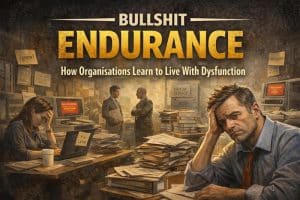

How Organisations Learn to Live With Dysfunction
Organisations rarely fail when the first things go wrong.
They fail much later, after they’ve learned how to live with things being wrong.
That is the part most people misunderstand.
Collapse doesn’t come from fragility alone.
It comes from endurance.
From the ability to tolerate dysfunction, absorb damage, and keep going just long enough for everyone to believe the system still works.
This is Bullshit Endurance, the phase where organisations mistake survival for strength, pain tolerance for resilience, and silence for alignment.
It’s the most dangerous stage of decline, because by the time it’s visible, it’s already normal.
What Bullshit Endurance Really Is
Bullshit Endurance is the organisational capacity to function despite knowing things are fundamentally wrong.
Not because the problems aren’t serious, but because people have adapted around them.
Work still gets done. Customers are still served. Reports still go out.
So leadership assumes the system is healthy.
It isn’t.
It’s being held together by people compensating for failure.
And that compensation has a cost.
How Endurance Begins: Small Compromises, Repeated
No organisation wakes up one day and says:
“Let’s normalise dysfunction.”
It starts with small, reasonable compromises.
- “We’ll fix that later.”
- “Just this once.”
- “We don’t have time right now.”
- “That’s not ideal, but it works.”
Each compromise makes sense in isolation.
Together, they form a culture of acceptance.
And once acceptance sets in, expectations quietly lower.
When “That’s Just How It Is” Becomes Policy
The most dangerous sentence in any organisation is:
“That’s just how it is here.”
That sentence signals the moment when people stop believing change is possible.
From that point on:
- Problems are anticipated rather than solved
- Inefficiency is planned for
- Workarounds replace fixes
Dysfunction stops being a problem. It becomes a feature.
And the organisation builds muscle memory for coping rather than correcting.
The Hidden Engine of Bullshit Endurance: Good People
Bullshit Endurance is powered almost entirely by competent, conscientious individuals.
Not the bullshitters.
The opposite.
The people who:
- Care too much to let things fail
- Absorb extra work quietly
- Fix problems without making noise
- Shield others from consequences
These people become human shock absorbers.
They keep things running, while protecting customers and even protecting reputations.
And in doing so, they protect the system from having to change.
Hero Culture: The Most Expensive Illusion
Every enduringly broken organisation celebrates its heroes.
The ones who:
- Stay late
- Pick up the slack
- “Make it work” no matter what
Leadership praises them. Peers rely on them. The system consumes them.
But heroics are not a sign of strength.
They are evidence of structural failure.
When heroism becomes routine, the system is already broken; it just hasn’t collapsed yet.
Why Leaders Misread Endurance as Health
From the top, endurance looks like stability.
Metrics still move. Deadlines are still met. Fires are contained.
So leaders conclude:
“It can’t be that bad.”
But what they’re seeing is buffering, not health.
They don’t see:
- The burnout
- Shortcuts
- Risk accumulation
- Silent disengagement
Because endurance hides damage, until it doesn’t.
The Silence Trap
Bullshit Endurance thrives on silence.
Not because people don’t see problems. But because speaking up has become pointless.
Over time, people learn:
- Raising issues changes nothing
- Naming problems creates friction
- Candour carries personal risk
So they stop.
They nod, comply and disengage internally while remaining physically present.
This silence is mistaken for alignment.
It isn’t.
It’s resignation.
How Endurance Warps Culture
Once endurance sets in, behaviour changes in predictable ways.
Excellence Becomes Optional
When outcomes matter less than appearances, effort follows incentives.
People do enough to survive. Not enough to excel.
Why overperform when it isn’t recognised? Why challenge bad decisions when it backfires?
Competence retreats underground.
Cynicism Replaces Trust
People stop believing what leadership says, not because leaders lie, but because language no longer maps to reality.
Town halls become theatre. Values become slogans. Initiatives come and go.
Cynicism is not negativity.
It’s a learned experience.
Mediocrity Stabilises
High performers burn out or leave. Low performers learn how to hide. Bullshitters thrive.
The organisation stabilises at a lower level of capability.
And that stability is deeply misleading.
Why Bullshit Endurance Feels Like Resilience
This is where many organisations fool themselves.
They say:
- “We’ve been through worse.”
- “We always find a way.”
- “We’re resilient.”
But resilience is the ability to recover.
Endurance is the ability to absorb damage without fixing the cause.
Endurance feels strong, gritty, and admirable.
It is none of those things.
It is a deferred collapse.
The Psychological Toll
Bullshit Endurance doesn’t just damage systems.
It damages people.
- Motivation erodes
- Identity fractures
- Pride disappears
People stop saying “my organisation” and start saying “this place”.
They stay for money, convenience, or fear, not belief.
That kind of disengagement doesn’t show up on dashboards.
But it’s lethal over time.
Why Nothing Changes (Even When Everyone Knows)
By the time Bullshit Endurance is established:
- Change is risky
- Disruption feels dangerous
- Failure is feared more than stagnation
The organisation has optimised for survival, not progress.
Any attempt to fix root causes threatens the fragile equilibrium.
So leaders choose:
“Better the dysfunction we know than the disruption we don’t.”
And endurance continues.
The Quiet Warning Signs
Bullshit Endurance has tells.
You’ll hear phrases like:
- “We don’t have the capacity to fix that.”
- “That’s outside our control.”
- “We’ve tried before.”
- “It is what it is.”
When those phrases dominate, the system has already adapted to being broken.
Why Endurance Is the Most Dangerous Phase
Bullshit Endurance is more dangerous than incompetence.
Incompetence fails quickly. Endurance fails slowly and convincingly.
It allows organisations to:
- Ignore early warnings
- Misread stability
- Delay hard decisions
By the time collapse begins, leaders are genuinely shocked.
They shouldn’t be.
The system told them for years. They just learned not to listen.
A Hard Truth
Endurance is not a virtue in organisations.
It is a survival mechanism that, left unexamined, becomes self-destructive.
If your organisation relies on:
- Unpaid overtime
- Informal fixes
- Silent compliance
- A handful of exhausted experts
You are not resilient, you are borrowing time.
Closing Thought
Bullshit Endurance is where organisations go to die slowly.
Not with drama. Not with headlines. But with quiet resignation.
It feels stable, at the same time feels familiar and even feels manageable.
Until reality demands competence again.
And when that moment comes, endurance will not save you.
Next week the third of the Bullshit series:
Bullshit Collapse, why failure always looks sudden, even when it has been years in the making.
Leave a Reply