The rules of leadership have changed. What worked a decade ago, or even five years ago, is no longer enough to drive teams forward in an increasingly complex world. Leaders today face a unique convergence of challenges. Distributed workforces, AI-assisted decision-making, rapid market shifts, and a workforce that demands authenticity over authority.
Yet many professionals in leadership roles are still operating from outdated playbooks. Wondering why engagement is slipping and results are inconsistent.
This analysis cuts through the noise to examine what effective leadership actually demands in 2026. We will look at the core competencies that have quietly become non-negotiable. The outdated assumptions that are holding capable leaders back. And the specific behavioural shifts that separate high-performing leaders from those who are simply managing the status quo. Whether you are stepping into a leadership position for the first time or refining an established approach. This breakdown will give you a clear, honest picture of where the bar sits today and what it genuinely takes to clear it.
The Gap Between Leadership Awareness and Leadership Competence
There is a critical distinction that most leadership development conversations in 2026 fail to make clearly: the difference between trend awareness and operational competence. Knowing what AI integration means, understanding the principles of ESG governance, or being able to articulate a capability framework are forms of literacy. They are not evidence of leadership. People demonstrate competence under pressure by working with real teams in ambiguous conditions where frameworks do not map neatly onto problems. That distinction matters because organisations are currently investing at scale in the former while measuring almost nothing about the latter.
DDI’s 2026 leadership research identifies AI integration and leadership capability-building as converging organisational priorities, a finding that reflects genuine urgency across the profession. Yet the measurement infrastructure supporting that investment remains structurally weak. Organisations still assess capability predominantly through self-reports, manager nominations, and programme completion rates rather than through verified behavioural outcomes under operational conditions. The result is a system that tracks participation convincingly while revealing almost nothing about whether leaders can actually perform when it counts.
Knowing and Demonstrating
Commentators frequently cite the reported 28% improvement in leadership bench strength among organisations using AI-driven L&D programmes as evidence of progress. That figure deserves scrutiny. In most organisational contexts, bench strength is assessed through succession-readiness ratings and assessment centre scores, not through demonstrated performance under pressure. When leadership skills gap data shows that only 11% of companies report having a strong leadership pipeline and 71% of leaders are assessed as not ready to lead their organisations into the future, a 28% improvement in bench strength tells us something improved. It does not tell us that the right things were measured.
This is the core problem with much of current leadership discourse. It conflates knowing about leadership with demonstrating it, and that conflation carries real organisational costs: disengaged teams, poor decision-making under pressure, and capability frameworks that exist on paper without verification in practice. As People Matters highlights, the gap is not access to content; it is the inability to convert learning into applied decision-making that drives performance.
The remainder of this analysis examines what verified competence actually requires, drawing on current evidence rather than trend cycle recommendations.
Why Traditional Authority Models Are Failing and What Replaces Them
Hierarchical leadership does not fail because of bad leaders. It fails because of bad architecture. The structural logic of positional authority creates compounding problems in complex, fast-moving environments: executives require multiple layers of approval before decisions move forward, managers filter and distort critical information as it passes through the hierarchy, and employees quickly learn that speaking uncomfortable truths can harm their careers.
The result is that senior leaders receive a systematically incomplete picture of organisational reality, while the people closest to problems lack the mandate to solve them. This is not a personnel failure; it is a design failure. According to Corporate Rebels’ analysis of non-hierarchical leadership, the rigid chain of command produces a specific quartet of failure modes: lack of agility, top-down control that breeds disengagement, bureaucracy overload, and territorial management where leaders protect positional power rather than enable performance. None of these are correctable by installing better people into the same structure.
Researchers and practitioners now widely document the shift away from this model as a defining leadership dynamic for 2026. Analysis from LinkedIn’s workplace trends research on traditional authority compared to modern leadership styles traces a clear progression: from command-and-control, through inclusive leadership, toward an emerging era of inspiration-based practice where people follow a leader not because of their title, but because of demonstrated transparency and care. Proaction International’s work, cited in LinkedIn Pulse analysis from January 2026, identifies this authority-to-inspiration shift as one of the structural trends accelerating across organisations, not a soft skills aspiration but a functional response to environmental complexity. The organisations resisting this shift are not being traditional; they are being slow.
Inspire and Define
Leaders and researchers should define inspirational leadership precisely because people frequently misuse the term. Inspiration is not a communication upgrade. A leader who delivers a compelling vision while their daily decisions contradict it does not generate inspiration; they generate cynicism, which is considerably more damaging than straightforward positional authority. Genuine inspiration requires behavioural alignment: the leader’s actions must be legible as evidence of the values they claim to hold. Communication skill can amplify that alignment, but it cannot manufacture it from absence.
Mid-level managers carry the sharpest version of this tension. They occupy a structurally pressured position, operating within hierarchical reporting structures that still expect compliance and upward information flow, while managing a workforce that expects to be led through trust, purpose, and autonomy. As Situational Leadership’s 2026 trends analysis frames it, mid-level talent has become the new backbone of modern organisations, yet they are routinely asked to speak two incompatible leadership languages simultaneously: authority upward, inspiration downward. This is not sustainable without corresponding movement from the senior layer.
The most reliable behavioural marker for genuine progress beyond positional authority is also the simplest: observe what happens when the leader is not present. If decisions stall, quality deteriorates, or problems escalate awaiting direction, the organisation is still running on positional authority regardless of how collaborative the leader appears in meetings. Teams that genuinely internalise their leader’s direction and values make sound decisions without direct supervision because they understand the reasoning behind decisions, not merely the decisions their leader would make. That distinction, between compliance with a person and commitment to a purpose, is where the structural transformation from authority-based to inspiration-based leadership becomes visible in practice.
AI and Leadership: Interrogating the Evidence Behind the Headlines
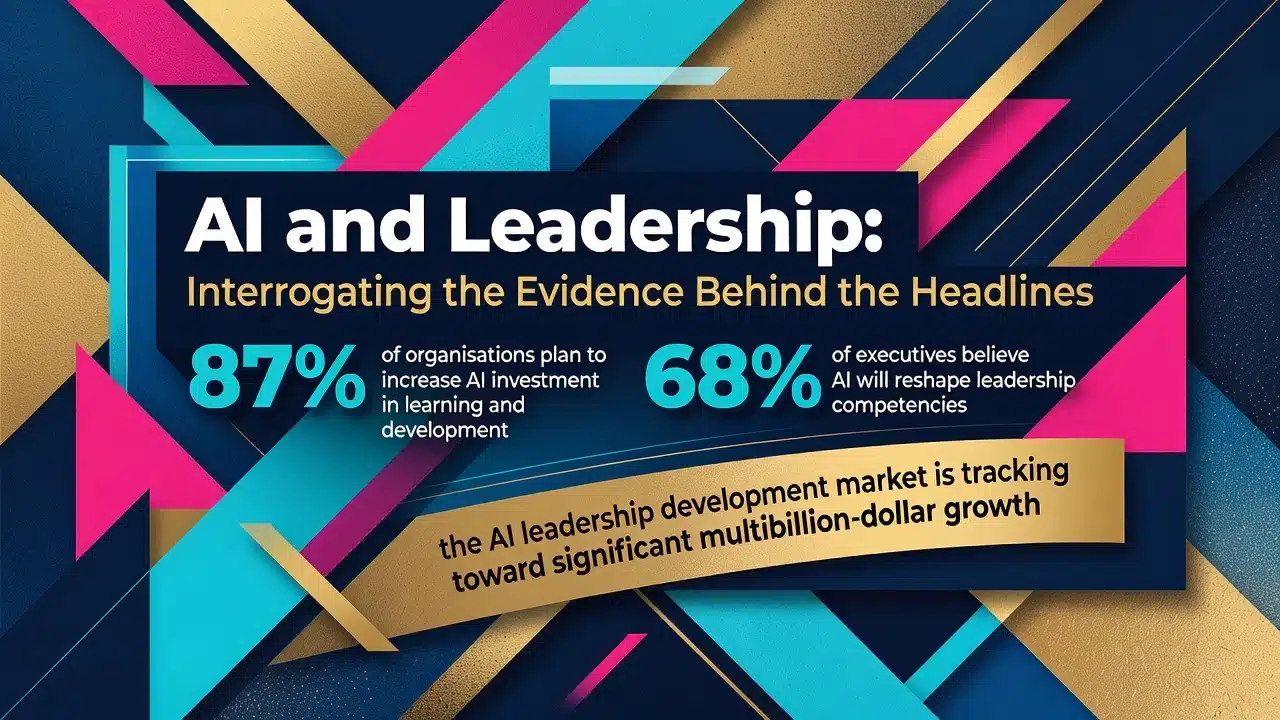
The numbers are arresting. According to aggregated industry data, 87% of organisations plan to increase AI investment in learning and development, 68% of executives believe AI will reshape leadership competencies, and the AI leadership development market is tracking toward significant multibillion-dollar scale by 2027. These figures circulate constantly through LinkedIn posts, conference decks, and think-pieces, and authors almost always present them without qualification. That absence of qualification is precisely where the analysis needs to begin.
The Source Problem Most Commentators Ignore
A clear pattern emerges when you trace these statistics to their source: organisations with a direct commercial interest in AI adoption generate the overwhelming majority of them. Platforms selling AI-powered coaching tools, consultancies offering AI-enabled talent analytics, and vendors packaging machine learning into development programmes are the primary architects of the data landscape informing leadership investment decisions.
This is not a peripheral concern; it is a structural validity problem. Leadership Development AI statistics published by careertrainer.ai aggregate secondary sources including McKinsey, Gartner, and Deloitte, yet provide no independent primary methodology, and careertrainer.ai is itself an AI coaching platform. More critically, intent to invest is not a demonstration of impact. Conflating the two is a critical thinking failure that most content enthusiastically commits. The 2026 Global Leadership Study from Harvard Business offers a more measured signal: 53% of respondents expect leaders to make greater use of AI in strategic decision-making, and 47% cited scalability as the most important attribute in selecting a leadership programme. These are credible directional data points. They do not, however, constitute evidence of durable behavioural change in leaders, and no peer-reviewed literature currently provides that evidence at scale.
Where AI Genuinely Adds Value, and Where It Does Not
There are specific functions where AI performs with demonstrable advantage in leadership development. Pattern recognition across large performance datasets, personalisation of learning pathways based on individual competency profiles, identification of high-potential candidates across organisations too large for human observation alone: these are legitimate capabilities with practical application. Problems emerge when organisations assume that AI’s functional strengths apply to domains outside its capabilities. People make ethical judgements by interpreting context, not by matching patterns from historical data. They build trust through consistent behaviour, vulnerability, and mutual accountability over time, and no algorithm can replicate that process. Adaptive judgement under genuine ambiguity, where the variables are novel and the stakes are real, remains a distinctly human competency.
The Human Capabilities AI Cannot Substitute
DDI’s 2026 leadership research identifies five specific capabilities that determine whether AI implementation drives organisational success or derails it. Critically, every one of these capabilities is human in origin, not technical. The implication is direct: AI tools succeed or fail based on the quality of leadership surrounding them, not on the sophistication of the tool itself. Leaders who treat AI adoption as a capability signal are making a category error. As HR transformation advisor Jason Averbook argues, the AI adoption gap is no longer a tooling issue; it is a leadership issue, and leaders must address mindset before skillset or toolset.
Uncritical adoption of AI in leadership development does not demonstrate capability maturity. It demonstrates trend compliance, and these are fundamentally different things. Capability maturity depends on people’s ability to understand a tool’s strengths and limitations, scrutinise the influence of commercial incentives on its data, and actively frame, interrogate, and override its outputs when necessary. Leaders who can make those distinctions are developing genuine competence. Leaders who cannot are simply moving with the current.
The Human Capabilities Most Resistant to AI Displacement
Broad frameworks about the “human advantage” are useful for orientation but insufficient for action. The more precise and practitioner-relevant question is this: which specific human capabilities are structurally resistant to AI displacement, and why? Four stand out as both durable and high-leverage: contextual ethical reasoning, psychological safety creation, adaptive narrative framing, and relational accountability. These are not soft skills in the dismissive sense of that phrase. They are cognitively demanding, developmentally complex, and organisationally consequential.
Contextual Ethical Reasoning
AI systems optimise for defined objectives within specified parameters. That is not a criticism; it is a description of how they function. The problem is that genuine leadership decisions rarely present as clearly bounded optimisation problems. They involve competing obligations, layered simultaneously: to shareholders expecting returns, to employees carrying uncertainty, to communities absorbing organisational decisions, and to an institutional reputation that compounds over years.
A leader deciding whether to restructure a team, disclose an emerging risk, or hold a partner accountable faces not a single objective function but a web of stakeholder trust dynamics with long-term reputational consequences. Over 60% of employers globally identify critical thinking, including ethical and contextual judgment, as the most important skill for the future of work, ranking it above technical expertise. This is not nostalgia for human judgment. It reflects a structural limitation: AI can surface data relevant to an ethical decision, but it cannot carry the weight of being genuinely accountable to the people that decision affects.
Psychological Safety Creation
The relational trust function of leadership cannot be delegated to an algorithm. Research consistently shows that psychological safety, the condition in which team members feel safe to speak up, challenge assumptions, and acknowledge failure, is established through sustained human behaviour over time. It requires a leader who has demonstrated trustworthiness not just in smooth moments but through repair after conflict, consistency under pressure, and genuine vulnerability. Notably, 63% of emerging leaders view AI coaching as complementary to, not a replacement for, human mentorship. That figure is significant precisely because it comes from a generation with the highest AI fluency. Even those most comfortable with AI tools recognise that the relational scaffolding of leadership development cannot be automated. AI can simulate encouragement and provide feedback at scale; it cannot carry the social and emotional weight of a human being who is genuinely invested in another person’s growth.
Adaptive Narrative Framing
When organisations face ambiguous change, people do not primarily need information. They need orientation. Adaptive narrative framing is the capacity to read a team’s emotional state in real time, translate strategic ambiguity into a story that gives people both direction and agency, and recalibrate tone and specificity as the situation evolves. This is distinct from communication skill in the conventional sense. It requires simultaneous processing of group affect, individual reactions visible in non-verbal signals, strategic context, and the accumulated history of the team’s experience together. Current AI tools can generate plausible narratives, but they cannot notice that one team member has gone quiet, sense a shift in the room’s energy, or adjust their framing mid-conversation in response to what is unfolding in front of them. That real-time, embodied attunement remains beyond the current capability of any large language model.
The Development Implication
The case for developing these capabilities is not defensive. Leaders should not be practising contextual ethical reasoning, psychological safety creation, and adaptive narrative framing because AI is advancing. They should be practising them because these are the highest-leverage leadership behaviours in any environment, AI-driven or otherwise. The practical implication is deliberate, structured practice: seeking out decisions that carry genuine ethical complexity rather than delegating them downward; building environments where psychological safety is tested and repaired, not just declared; and rehearsing narrative framing in real change scenarios rather than leaving it to instinct. As AI assumes more execution tasks across organisations, these capabilities will become more visible, more consequential, and more directly linked to leadership effectiveness. The leaders who develop them systematically now will not be defending against AI; they will be building the irreplaceable core of what leadership actually means.
Culture Is Not a Leadership Initiative. It Is the Leadership Result.
Most leadership teams treat culture as a category of work. They commission workshops, launch values programmes, and publish cultural frameworks with carefully chosen language. The assumption embedded in this approach is that culture is something you build through deliberate initiative. That assumption is wrong. Culture is not an input into your organisation. It is an output of it. Specifically, it is the accumulated residue of every decision your leaders have made, every behaviour they have tolerated, and every result they have rewarded across every level of the organisation over time. As Harvard Business School Online frames the mechanism, leaders shape culture through the decisions they make, the behaviours they model, and the values they reinforce or undermine in practice. The programme does not create the culture. The behaviour does.
This reframing has structural implications for how organisations position culture within their operating models. The Innovative Leadership Institute’s six emerging leadership shifts for 2026 are instructive here. Rather than treating culture as a standalone programme adjacent to strategy, the framework places culture at the centre of enterprise system design and leadership capability maturity. The distinction matters. A standalone programme can be resourced, scoped, and closed. A system design element cannot be switched off. It is either working for your strategy or working against it, every day, whether or not anyone is paying attention to it.
The Cultural Environment
The practical consequence is this: every significant initiative your organisation is running right now, whether it is an AI adoption programme, an ESG commitment, or a capability development investment, is operating either with or against the cultural environment your leadership has already created. Culture functions as a force multiplier when alignment exists and as a force reducer when it does not. Gartner research consistently identifies cultural resistance as a primary driver of technology adoption failure, and AI implementations are no exception. When the existing culture rewards risk avoidance, punishes visible failure, and recognises individual performance over collaborative outcomes, no AI strategy survives contact with it at scale.
The most common and costly failure mode in leadership development follows directly from this logic. Organisations invest in programmes designed to shift leadership behaviour while simultaneously maintaining reward and recognition systems that continue to incentivise the old behaviour. The result is not incremental progress. It is zero net change. Employees are not confused by this contradiction. They resolve it immediately. They observe what behaviour actually gets recognised, promoted, and financially rewarded, and they replicate that behaviour regardless of what the programme materials say. The programme communicates aspiration. The reward system communicates reality. Reality wins.
Behaviour and Strategy
This brings the analysis to a diagnostic question every leader can apply without external consultants or engagement surveys. Ask this directly: does the behaviour your culture actually rewards match the behaviour your leadership strategy says it values? If your leadership strategy says it values psychological safety, but your reward system promotes those who project certainty and penalises those who surface problems early, your team is not following the strategy. They are following the reward system. If your capability development programme emphasises collaboration but your performance metrics and bonus structures remain individually weighted, the programme will produce no sustained cultural shift. The behaviour your organisation consistently models and celebrates is the culture you actually have, irrespective of any documentation that says otherwise. Answering that diagnostic question honestly is not a culture initiative. It is the beginning of genuine leadership accountability.
ESG Has Moved from Compliance to Core Leadership Competency
The framing of ESG as a compliance function managed by a specialist team is no longer operationally accurate. In 2026, ESG has become a strategic lens that competent leaders are expected to apply across resource allocation, team design, supplier selection, and stakeholder communication. Regulatory frameworks such as the Corporate Sustainability Reporting Directive (CSRD) and the Corporate Sustainability Due Diligence Directive (CSDDD) have created cascading governance obligations that reach well below the C-suite, requiring mid-level leaders to make ESG-relevant decisions as a routine part of their operational role. The question is no longer whether ESG applies to your function. The question is whether you are applying it deliberately or by default.
For intermediate leaders specifically, the career implications are concrete and immediate. A study from Fundação Getulio Vargas explicitly highlights the strategic role of mid-level leaders in the ESG agenda, validating what hiring data is increasingly confirming: ESG fluency is entering promotion criteria and executive selection frameworks. Companies across sectors are actively restructuring leadership to navigate this environment, including creating new C-suite roles with explicit ESG mandates. Leaders who treat ESG as peripheral or above their pay grade are, in practice, signalling a ceiling on their own enterprise-level thinking, precisely the quality that distinguishes managers from senior leaders in selection conversations.
Common Objections
The most common objection from mid-level leaders deserves a direct response: ESG is not outside your sphere of control. Every team leader operates three levers that carry genuine ESG weight. First, team composition and inclusion practices represent the social dimension of ESG in its most immediate form; how you build teams, whose perspectives you integrate, and how fairly you distribute opportunity are not soft concerns but auditable governance signals. Second, decision-making transparency is a governance lever; documenting how decisions are made, on what basis, and with what trade-offs acknowledged reflects the due diligence logic embedded in current regulatory frameworks. Third, vendor and supplier choices within your remit carry environmental and social implications; commissioning a software tool, selecting a training provider, or choosing a contractor involves decisions that aggregate into organisational ESG exposure. None of these require a sustainability qualification. All of them require intentionality.
The connection between ESG and team culture is not incidental. Teams that experience fair, transparent, and purpose-driven leadership tend to produce better ESG-adjacent outcomes organically, without requiring a compliance programme layered on top. This is where psychological safety intersects with governance: when team members feel safe to raise concerns, question decisions, and name misalignments between stated values and observable behaviour, the organisation gains an early warning system that no audit process can replicate. Responsible leadership competency, as framed in peer-reviewed research published in the Sustainability journal (2026), maps directly to measurable sustainability impact, suggesting that the quality of daily leadership behaviour is the real mechanism of ESG integration, not the reporting architecture built around it.
The final Risk
The final risk worth naming is performative ESG adoption. When organisations adopt ESG language in response to brand pressure rather than genuine integration, they create a specific and well-documented credibility problem. The same political and regulatory scrutiny that is driving some companies toward “greenhushing” (maintaining ESG substance while reducing public ESG language) is also exposing the gap between leaders who perform ESG commitment and those who embed it in their decisions. That gap behaves exactly like any other leadership behaviour gap: visible to the people closest to you, corrosive to trust over time, and ultimately more damaging than no ESG engagement at all.
Continuous Learning Is No Longer a Virtue. It Is a Minimum Requirement.
The cross-source consensus on this point is no longer ambiguous. Continuous learning and personal agility are now baseline leadership requirements, not competitive differentiators. With 87% of organisations reporting existing or imminent skills gaps, and the World Economic Forum’s projection that 50% of all employees would require reskilling due to AI having already arrived as a present condition, the frame of “learning-minded leader as exceptional” has collapsed. What this shift demands, practically, is a restructuring of how leaders approach their own development. Annual performance cycles and budget-dependent L&D conversations are structurally inadequate responses to a continuous capability demand. The relevant metric, as Fortune 500 L&D functions have begun tracking, is not whether learning is happening but how quickly it is converting into updated decision-making.
The more uncomfortable distinction, however, is between performative and operational continuous learning. Performative learning is visible and measurable in ways that feel productive: credentials accumulated, conferences attended, AI literacy modules completed. It generates activity data and signals effort. What it rarely generates is genuine capability change, because it separates content consumption from decision application. Operational continuous learning works differently. It applies new thinking to live decisions, updates mental models when evidence contradicts existing assumptions, and actively seeks disconfirming feedback rather than avoiding it. The psychological pull toward performative learning is real; for leaders, credential collection carries status signals and risk-avoidance logic that operational learning does not. Acknowledging this dynamic is a prerequisite for escaping it.
Cited Statistics
The frequently cited statistic that organisations using AI for talent development report 40% faster skill acquisition rates deserves careful handling. The efficiency gain is genuine, particularly in content personalisation and pacing. But speed of acquisition only creates value when what is being acquired maps directly to real capability gaps in real decision contexts. Faster completion of modules optimised for engagement metrics rather than operational applicability does not develop leaders; it accelerates the production of performative ones. AI-assisted learning tools require the learner to supply an honest capability gap diagnosis. The tool cannot substitute for that honesty, and without it, velocity becomes a liability.
The learning habits that consistently distinguish high-capability leaders from credential collectors share a common structure: they are applied rather than passive. Deliberate reflection practices involve scheduled, structured review of recent decisions against intended outcomes, not general journaling. Structured peer challenge is not networking; it is forums where assumptions are actively stress-tested by informed peers with permission to disagree. External perspective seeking draws inputs from outside the leader’s industry or functional domain, specifically to surface blind spots that internal echo chambers cannot reveal. Systematic after-action review, embedded at the team level rather than reserved for personal use, functions as a learning multiplier that extends individual capability development into organisational performance.
Competence Development
Underpinning all of this is a requirement the platform returns to consistently: real competence development starts with an honest assessment of current capability gaps, not the consumption of trend-aligned content. Seventy percent of employees report lacking skills needed for their current roles, yet only 44% believe they are inadequately equipped. The self-assessment gap is particularly acute for leaders, where positional authority routinely suppresses disconfirming feedback. Fluency in current leadership vocabulary, whether AI integration, ESG strategy, or digital transformation, does not constitute functional capability. The starting point for genuine development is a rigorous, evidence-based gap diagnosis that is deliberately insulated from ego-protective distortion.
How Poor Leadership Actually Derails AI Adoption
The statistics on AI deployment look, at first glance, like a success story. Global AI spending has reached $301 billion in 2026, and 91% of businesses now use AI in at least one capacity. Yet MIT’s Project NANDA found that 95% of enterprise generative AI pilots fail to deliver measurable financial returns, and McKinsey reports only 39% of organisations register any EBIT impact from AI investment. This is not primarily a technology problem. The research consensus points consistently toward leadership as the critical failure variable, and three specific leadership failure modes account for the majority of that gap.
Failure Mode One: Framing AI as a Cost-Cutting Tool
The most immediately damaging leadership behaviour is positioning AI adoption as a mechanism for headcount reduction. Current data shows that 60% of organisations plan layoffs for non-adopters, and 69% are already conducting AI-related redundancies. When employees perceive AI tools as instruments of their own elimination, the rational response is surface compliance paired with deliberate disengagement. Workers appear to adopt the tools while ensuring genuine integration never happens. This is not passive resistance; it is a predictable psychological response to an existential threat. The result is organisations that report near-universal deployment alongside near-zero ROI, because the honest feedback loops that would identify what is and is not working have been completely foreclosed. Psychological safety is not a soft concept here; it is the operational precondition for genuine adoption.
Failure Mode Two: Delegating Without Strategic Ownership
The second failure mode is subtler but equally consequential. When leaders announce AI ambitions and then hand implementation responsibility to technical teams without maintaining strategic ownership of the outcomes, fragmentation is the inevitable result. Research shows that 75% of executives admit their company’s AI strategy is more for show than substantive internal guidance, and 39% have no formal plan to drive revenue from AI tools. The downstream consequence is visible in adoption patterns: almost 90% of employees use personal AI for work, while fewer than 15% of Fortune 500 companies provide enterprise AI tools officially. Strategic ownership does not mean technical involvement; it means defining which problems AI should solve, holding cross-functional teams accountable for outcomes, and maintaining consistent organisational alignment around AI’s purpose.
Failure Mode Three: Championing Tools Without Developing Evaluative Judgement
The third failure mode is perhaps the least examined. Research shows that 94% of executives use AI tools for at least 30 minutes daily, with 64% spending two hours or more. Heavy usage without the capacity to interrogate outputs is not efficiency; it is systematic exposure to undetected error at executive level. A leader who cannot evaluate the quality of AI-generated analysis cannot distinguish a confident hallucination from a sound recommendation. That is not a minor gap; it is abdicated judgement dressed as productivity. Building evaluative capacity does not require technical expertise, but it does require deliberate effort to understand how AI systems produce outputs and where they characteristically fail.
The Constructive Frame: DDI’s Five Leadership Capabilities
DDI’s research on AI success identifies five leadership capabilities as critical to whether organisations capture or destroy value through AI implementation. Notably, none of the five are technical. They centre on critical thinking about AI outputs, communicating change effectively, coaching teams through sustained uncertainty, making sound decisions with incomplete information, and maintaining clear accountability for outcomes. The structural significance of this framework is considerable. If the capabilities that determine AI success are relational and judgement-based, then organisations investing heavily in technical infrastructure while underinvesting in leadership competence are, quite precisely, solving the wrong problem. The data supports this conclusion at scale: leadership quality is not a supporting variable in AI adoption. It is the primary one.
What This Means for How You Actually Develop as a Leader
The analysis throughout this article has established what capabilities matter. The harder question is how you actually build them. The answer requires a fundamental reframe: leadership development is not programme attendance. It is deliberate practice of specific capabilities, applied to real situations, with structured reflection on what changed as a result. The four capabilities identified here, contextual ethical reasoning, psychological safety creation, culture diagnosis, and AI-output interrogation, are not abstract competencies. They are practitioner skills that atrophy without repeated, intentional use and sharpen only through application under real organisational conditions.
The evidence supports a clear development sequence that most professionals invert. The default approach is to consume content first and then attempt application later, if at all. The research-supported sequence runs in the opposite direction: self-assessment against specific behavioural markers before any content consumption, application of new frameworks to live team situations during the development period, and structured reflection on measurable outcomes after. This sequence works because it anchors learning to actual capability gaps rather than to whatever content happens to be available. Without prior diagnosis, content consumption is essentially random. The Oxford Group’s Leading in an AI World report, published in July 2026, makes the cost of this inversion explicit: leadership maturity is currently being outpaced by AI adoption, and programme attendance without deliberate capability-building is a primary contributor to that gap.
The Personalisation Argument
The personalisation argument requires scrutiny here. Seventy-eight percent of professionals prefer AI-personalised learning paths over generic programmes, and that preference is legitimate. Personalised learning is more efficient and more likely to be completed. But personalisation is only as valuable as the underlying capability model it draws from. An AI-personalised path built on a generic competency framework does not solve the diagnosis problem; it accelerates delivery of the wrong content. The capability model has to be specific, behavioural, and evidence-grounded before personalisation adds any meaningful value.
This is where DarrenWalley.com‘s articles and frameworks are designed to function: not as trend commentary, but as practical analytical tools built around real organisational challenges. The frameworks here are constructed to support the diagnostic step that most development approaches skip, giving leaders a specific basis for identifying where their practice is strong and where it is not yet operational.
The leaders who will perform best over the next three years are not those who consumed the most leadership content. They are the ones who most accurately diagnosed their own capability gaps and acted on that diagnosis consistently. That is not an aspirational claim; it is the logical consequence of everything the research in this article establishes. AI is scaling. Organisational complexity is not simplifying. The limiting variable, confirmed by McKinsey, Harvard, and the WEF in convergent 2026 research, is human leadership quality. Precise self-diagnosis followed by deliberate practice is how that quality improves. Everything else is just noise moving faster.
The Leadership Standard Worth Meeting
The 2026 leadership conversation has produced an abundance of frameworks, trend reports, and competency models. What it has produced far less of is the harder discipline of distinguishing between leaders who know about leadership and leaders who demonstrate it when conditions are difficult, ambiguous, or politically costly. That gap is the central argument running through this analysis, and it does not close through more reading.
Three competencies define the standard worth meeting. Human judgement capabilities that AI cannot replicate, specifically the contextual, ethical, and relational reasoning that pattern-matching tools cannot supply. Cultural diagnostic honesty, the willingness to seek disconfirming evidence about your own leadership environment rather than managing feedback into comfortable conclusions. And continuous learning that produces changed behaviour under real conditions, not credentials that accumulate without altering how decisions actually get made.
The single most useful action you can take today is this: identify one decision you made in the last 30 days that relied on your title rather than earned trust. Then ask, with genuine honesty, what that decision would have looked like if alignment had replaced compliance, if shared reasoning had replaced directive, and if voluntary commitment had replaced positional authority.
The leaders who build genuinely high-performing teams in an AI-saturated environment are not the ones who track trends most efficiently. They are the ones developing real competence now, while most peers are still deciding which trend to follow.
Leave a Reply